Understanding Pickle: a beginner’s guide and review
What our 2020 Pickle Finance review got right, what it missed, and the APY math that still holds.If you've seen a DeFi farm advertise four-digit APY and struggled to work out what your capital would really earn, this rewrite of our 2020 Pickle Finance review has the answer. You'll learn how Pickle went from Vitalik Buterin's praise to a $19.7M exploit in two months, why a risk you disclose but discount is worse than one you never saw, and how to convert any APY figure into a daily yield you can actually reason about.
This is a substantial revision of our September 2020 review of Pickle Finance. The original praised a two-week-old farming protocol for its originality and speed of execution. Two months later the protocol was exploited for roughly $19.7M, it then merged into Yearn, and in 2025 it shut down for good. Rather than erase the original, we have rewritten the piece as a lessons-learned account, quoting what we said against what happened. Nothing here is a recommendation or investment advice.
What we said in September 2020
Pickle Finance launched with a genuinely original pitch. Off-peg stablecoins create instability across DeFi, so Pickle paid elastic $PICKLE incentives to push $DAI , $USDC , $USDT , and $sUSD back toward their pegs: below-peg pools earned more $PICKLE , above-peg pools earned less, and farmers were expected to rotate their liquidity accordingly. Vitalik Buterin praised the team's adoption of quadratic voting two days after launch.
We were impressed too. Our summary read:
Pickle is probably the most interesting “food project” out there, with a refreshing approach and a great speed of execution.
and closed with:
While the tokenomics model must mature in order for the project to become a mainstay of DeFi, I give them plenty of kudos for their originality.
The warning we wrote, then discounted
The original review named the exact risk in its legitimacy section:
Currently, its contracts are unaudited, and the developers are only publicly known for moderating on the Pickle Finance Discord channel.
And repeated it in the summary:
Surely, there are risks in DeFi, and Pickle is no exception, with anon devs and unaudited contracts.
We treated the team's multi-sig and $PICKLE -only devshare as the answer, because the question on everyone's mind in 2020 was rug-pulls. But a multi-sig protects against a malicious team, not against broken code. We even described, approvingly, the team's plan to build vaults around the very primitive that would later be turned against the protocol:
These vaults are meant to utilize flash loans to leverage and arbitrage stablecoins in order to create further pressure to bring them to their peg while generating returns to be distributed to $PICKLE holders.
What happened next
On November 21, 2020, two months after this review was published, a flash-loan exploit drained roughly $19.7M in DAI from Pickle's jars; Halborn's post-mortem walks through the mechanics. Days later, Pickle merged with Yearn, and victims of the exploit received CORNICHON, a compensation token minted pro-rata to their losses.
The merged project ran quietly for years but never recovered its momentum. In 2025 the team formally closed the jar: the remaining treasury of roughly 170,000 USDC was distributed to holders, and the UI was disabled on October 1, 2025.
The APY math
The original review's point still holds: headline yield figures mislead without compounding and TVL context, and that applies to yield farming more broadly. Its worked example, though, muddled APR and APY, so we have corrected the math below while keeping the lesson.
APY (annualized percentage yield) in DeFi projects is a piece of core information for users to understand. Yield is often displayed annualized based on current conditions, even when those conditions are expected to change.
For example, APY on the $PICKLE –$ETH pool is based on the current rewards of 5 $PICKLE per block, even when these rewards are set to be halved in less than 2 days.
These yields are highly variable since rewards are a fixed amount of $PICKLE per block, the total value locked (TVL) will affect it. If the TVL goes up by 50% on that pool, the reward will be diluted in an inversely proportional manner, that is to say, by –33.3%. If the price of $PICKLE goes down by half, the APY will halve, but in actual fact, you will suffer an actual loss of –25% of your capital in the pool (each paired asset is half-weighted in Uniswap) plus an impermanent loss of –5.719%, so a total loss of capital of –30.719% + a loss on the future value of the investment since the reward has gone down. This will be offset by the trading fees earned during the period, which will be based on the trading volume, the trading fee, and your stake in the liquidity pool.
The best way to estimate return-on-investment (ROI) is to understand the investment, convert the APY into a more manageable timeframe (for DeFi, daily yield should work in most cases), and understand the assumptions. You may be able to model the interest under various scenarios for each variable in the equation. The key distinction is APR versus APY. A nominal APR states a simple annual rate with no compounding, so dividing it by 365 gives a daily rate, by 52 a weekly rate, and by 12 a monthly one. An APY already has a compounding assumption baked in, so you cannot divide it out that way, and you must not compound it a second time.
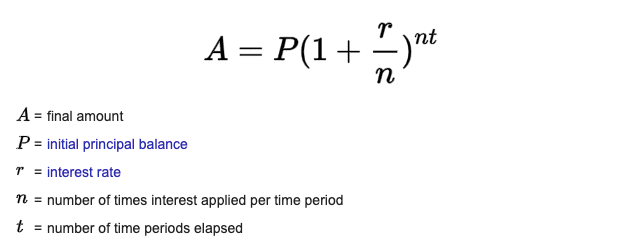
The gap between the two is enormous at DeFi's headline rates. A genuine 1000% APY means your balance ends the year at roughly 11x the principal, an equivalent daily compounding rate of about 0.659% (since 1.00659 to the 365th power is about 11). But if a dashboard takes a 1000% nominal APR and compounds it, the same underlying reward is advertised as a far larger effective APY:
| 1000% rate quoted as | Compounding | Effective result |
|---|---|---|
| APY | already included | ~11x (1000%) |
| Nominal APR | none (simple) | ~11x (1000%) |
| Nominal APR | monthly | ~1,440x (~144,000%) |
| Nominal APR | weekly | ~9,380x (~938,000%) |
| Nominal APR | daily | ~19,250x (~1,925,000%) |
These returns are not attainable in practice, since your own re-investing dilutes the per-block rewards and the assumptions rarely hold for a day, let alone a year. The point is that the same yield can read as 1000% or as nearly two million percent depending on whether it is quoted as an APR or a compounded APY, so always check which one a protocol means. An APY of 1000% is unlikely to be sustained for a year. Even 1% daily yield that can be compounded daily leads to an amazing 37.8x yearly ROI.
Keep in mind that transaction fees may also affect your deposit, compounding, and withdrawal strategies. In extreme cases, transaction fees like high gas prices will render your gains meaningless or cause you losses.
Do not play around with money that you do not have or cannot afford to lose, or with investment products or strategies that you do not understand.
What we take from it
A disclosed risk is not a discounted risk. We wrote "anon devs and unaudited contracts" and then gave the project kudos for originality. The review's own words contained the outcome; we simply weighted novelty over exposure. When a risk makes it into your own writing, treat it as the headline.
Speed of execution cuts both ways. The pace we praised is the same pace that put tens of millions of dollars behind unaudited code. For founders, shipping velocity is only an asset when the blast radius of a mistake is contained.
And evergreen math outlives any protocol. Pickle is gone, but the APY section above is as useful for evaluating today's yield programs as it was for a 2020 farm. The perishable part of a review is its verdict; the durable part is the method, and we now try to write, and read, every review with that split in mind.
Read Next



straight to your inbox