What is crypto arbitrage & how to make the most of it?
Cryptocurrency arbitrage is a popular way to make money in digital asset markets.If you've watched the same coin trade at different prices on two exchanges and wondered whether that gap is money you can legally capture, this article has the answer. You'll learn how simple and triangular arbitrage work in practice, how to position funded accounts across exchanges before an opportunity appears, and what the arbitrage bot market actually looks like in 2026.

You may have heard the word before when researching earning opportunities in Crypto. So, what exactly is arbitrage? Arbitrage occurs whenever an asset is sold in different markets at different prices, and an opportunity for quick profits from "buy low, sell high" presents itself momentarily. Arbitrage opportunities are common in Crypto because digital assets tend to be listed across multiple markets.
In this article, we will explore the legality of crypto arbitrage trading, the process to earn by arbitraging in crypto markets, and instructions on how to use arbitrage bots, including a look at the crypto arbitrage bots still worth considering in 2026.
Is crypto arbitrage legal?

Arbitrage itself is generally lawful as a market activity, in Crypto as in other asset categories. But "legal" is not unconditional: whether a specific arbitrage is permitted depends on the jurisdiction, the asset, the venue, and how you trade. Market-manipulation and wash-trading rules, securities and commodities registration, tax, and local crypto restrictions can all bear on it. In fact, arbitrage is a natural economic phenomenon that allows for competitive pricing to be offered for the same good in different markets. Traders who engage in arbitrage are called arbitrageurs by economists and market analysts alike. Arbitrage reduces directional exposure, since the buy and sell operations occur close together, but it is not risk-free: execution and slippage, exchange counterparty risk, transfer and settlement delays between venues, and faulty or mispriced bots can all turn a spread that looked certain into a loss. Arbitrage also tends to be short-lived as arbitrageurs (or their trading bots) exploit the opportunity until it disappears. You will see arbitrage in all sorts of goods and asset classes, from commodities like gold to stocks to financial instruments like prediction contracts (bets) for sporting and political events. There is even arbitrage in college textbooks. Arbitrage will continue to be a feature of markets as long as there are market inefficiencies, and arbitrage will continue to be viewed favorably by academics and policymakers alike as arbitrageurs actually correct these inefficiencies as they arbitrage.
In Crypto, arbitrage has been there since the very beginning and continues to play an important role. Although it is much more diverse now, crypto markets started as dispersed commodity markets with Bitcoin going international very quickly. Restrictions in certain markets provided notable differences in pricing, with the famous Korean kimchi premium being a prime example: Korean buyers had to pay as much as 40% more for every bitcoin as U.S. buyers did during the height of the cryptocurrency boom of 2017. With Korea being the third-largest Bitcoin market, such inefficiencies have propelled crypto arbitrage trading as a major form of trading in cryptocurrency. One notable surge in popularity occurred during the bear market of 2018–2020 ("Crypto winter"), as arbitrage is bull-bear agnostic, an arbitrageur makes money whether markets are in full swing up or down.
Please note that arbitrage is not legal everywhere by default: cryptocurrency trading or holding is restricted or banned in a number of jurisdictions ( Law Library of Congress). If the reason for a high price premium is the illegality of crypto activity in a certain market, you may be breaking the law by trying to conduct arbitrage (or any other commercial activity that's legal elsewhere) on that market.
How to make money on arbitrage with crypto?
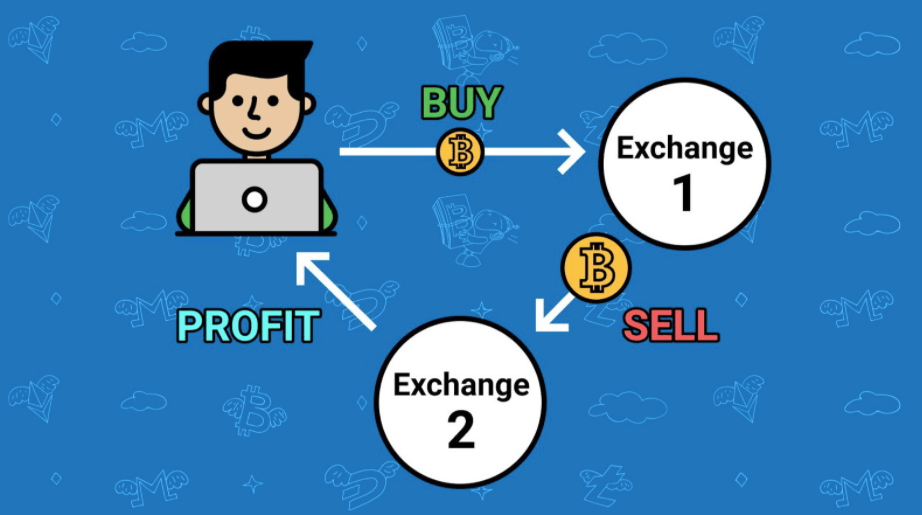
Here is a step by step guide on how to make money on arbitrage with cryptocurrencies:
- Monitor the market. First, you must find opportunities for crypto trading arbitrage. You may find these by monitoring a cryptoasset like $BTC , $ETH , or $XRP that are traded against many pairs and in a wide variety of markets, and check the different exchanges for a pair of your choosing (e.g. $BTC /USD) for simple arbitrage. You could also check in the same exchange, where arbitrage opportunities will occur between different pairs in real terms, i.e. triangular arbitrage.
- Position the buy and estimate profitability. You will need to consider your transaction costs and other fees before you determine whether this arbitrage opportunity makes sense. If the market is volatile and transactions are slow, then the opportunity might be lost by the time your trade goes through. In reality, arbitrageurs prepare by being well-positioned with funded accounts in many cryptocurrency exchanges to be able to move fast in reaction to all kinds of profitable opportunities. This works by, for example, splitting 1 $BTC among two exchanges, and buying in one and selling on the other simultaneously.
- Execute the arbitrage by exiting the trade. Crypto arbitrage trading operations should be simple as to be executed simply e.g. you have bought $BTC in Coinbase Advanced Trade with $USD to sell it in Bithumb in $KRW , you would need to convert back from $KRW to $USD to fully exit the trade, realize your new position, and make a final estimate of your costs. Don't forget that, if you live in a jurisdiction that taxes investments or trading activity, you need to keep an account of any profits and losses incurred through arbitrage.
While these things may seem simple to an experienced trader, the biggest hurdle for a retail investor may be finding worthwhile opportunities. Dedicated scanner tools exist to help. One early example was a free browser extension from the exchange Bitbns, which notified traders of arbitrage opportunities across a few major exchanges, ranked them by volume, and estimated the time to complete each trade. It has not been maintained since 2021, though, and stopped working once Chrome phased out Manifest V2 extensions in 2025, so treat it as history and reach for a currently maintained scanner instead.
Even with such monitoring tools, it is important to know you will be competing for opportunities with other arbitrageurs, including sophisticated trading funds aided by trading bots. Given this landscape, a good option for many retail investors is to use a crypto arbitrage bot.
How to use a crypto arbitrage bot?

Crypto arbitrage bots are offered as a service by makers of algorithmic and trading bots. Bots are software programs that mimic tasks, often tasks that humans otherwise have to manually do. The idea of these bots rests on the assumption that arbitrage strategies result in a loop of processes or task lists to execute trades that would benefit from automation. Moreover, since cryptocurrency markets are open 24/7, a piece of software running around-the-clock to be better fit-for-purpose, particularly for an individual investor that needs to dedicate time to other priorities (including sleep). If developed correctly, such bots would also be able to process large amounts of data more efficiently and effectively than humans. Of course, bots have no hunches, and only process whatever interpretation(s) of the market they were programmed for. Bots also cannot understand the significance of emergent technologies or detect catastrophic threats. Also, remember that market movements often happen on sentiment – i.e. news, announcements, or even well-timed tweet by an influencer – and most bots out there rely on price, volume, and other market data to make decisions. Of course, trading bots — with the help of data mining, natural language processing, and machine learning — keep getting better at using sentiment data to complement their strategies, but as with any technology, there are inherent limitations.
So, should budding arbitrageurs like yourself consider using such bots? The reality is that in Crypto as in other markets like forex, equities, and commodities, most sophisticated arbitrageurs use bots as a tool to aid them in staying on top of the market. Outside of arbitrage, other traders also use bots or algorithms to harness the advantages in speed and data processing that computers have over humans. Keep in mind that no trading bot is immune to downtime, bugs, and calibration or logic errors on their code.
Remember, if you choose to go for using a bot in your journey as a crypto arbitrageur, find a reputable provider, preferably one that's been up and running for some time. Besides faulty bots, a few scammers out there have used the promise of a great bot as a lure to collect money that will be outright stolen. None of this is financial advice, so please do your own research and proceed with caution.
The best crypto arbitrage bots in 2026

The most established provider of a dedicated arbitrage bot today is Cryptohopper:
- Cryptohopper. An advanced cloud-based platform with copy-trading features, Cryptohopper supports crypto arbitrage trading as well as other strategies like market-making and auto-trading. Strategy design and backtesting tools are also available on the platform, and both exchange and triangular arbitrage sit on its higher-tier plans, which bundle a lot more functionality than arbitrage alone.
A word on general automation platforms: 3Commas is well established for DCA, grid, and signal bots, but it offers no dedicated arbitrage bot or arbitrage tools ( per its own help center). You can approximate arbitrage there only by feeding TradingView signals or a custom strategy into its signal bots on a paid plan, so we don't count it as an arbitrage-bot provider.
The field has consolidated since we first published this piece. Shrimpy discontinued its consumer offering and pointed its users toward Cryptohopper. HaasOnline is still operating and offers consumer cloud plans (with a free trial) alongside its enterprise TradeServer. The free open-source generation has largely gone unmaintained too: ZenBot is archived on GitHub with no updates since early 2022, Blackbird (the bitcoin-exclusive arbitrage bot) has seen no meaningful maintenance for years, and Catalyst has been unmaintained since the end of 2018. Their repositories remain useful reading if you want to study how an arbitrage engine is put together, but none of them should be pointed at a funded exchange account today.
In summary, crypto arbitrage trading is a healthy part of crypto markets, executable between exchanges and within an exchange's multiple trading pairs. It is generally lawful, but whether a given arbitrage is permitted still depends on your jurisdiction, the asset, the venue, and how you trade (see the legality section above). This type of trading was one of the first significant strategies in the early days of Crypto. Nowadays, crypto arbitrage bots are one of the most popular ways to practice this strategy in crypto, which will continue to evolve and mature together with the market as a whole.