Understanding Celsius Network: a review
A post-mortem of our 2020 Celsius review, rewritten after the collapse, the bankruptcy, and the founder's fraud conviction.
If you've watched a platform promise 9% yield and a loyalty token and wondered how the whole industry missed the warning signs, this rewrite of our 2020 Celsius review shows how the pitch worked. You'll learn how the 90-95% value-return story recruited depositors, how CEL loyalty tiers doubled as a price-support mechanism, and which signals separate a real lending business from a sales narrative.
This article is a substantial revision of the review we published in July 2020. Celsius Network froze withdrawals in June 2022 and filed for Chapter 11 bankruptcy the following month. Founder Alex Mashinsky was sentenced to 12 years in prison for fraud and market manipulation, received permanent trading and registration bans from the CFTC, and in April 2026 settled with the FTC for $10M and a lifetime crypto-industry ban as the cases wound down. Earn creditors received partial recoveries through the bankruptcy, though what any creditor actually got back depends on their claim class and on how their crypto was valued at the July 2022 petition date, so a single headline percentage flattens a genuinely complicated distribution. Like most of the industry, we took the pitch at face value in 2020. We have rewritten the piece as a post-mortem: what the pitch actually was, which claims turned out to be the sales narrative prosecutors later dismantled, and what a founder should watch for when the next version of that pitch arrives.
What we wrote in 2020
The original review closed like this:
Celsius Network is a groundbreaking DeFi app that has come a long way in realizing the promises it made in its Whitepaper. Celsius Network offers some of the best rates on loans and savings in Crypto.
Earlier it went further:
Needless to say, the Celsius Network is one of the most successful DeFi applications in existence.
We believed that, and so did most of the industry. Celsius reported $700M+ in assets under management, $8B+ in originated loans, offices in London, New York, and Tel Aviv, and a founder credited with inventing VOIP. Every one of those numbers came from Celsius itself. Almost none of them was independently verifiable, and we passed them along anyway. That is the first lesson: a review built entirely on self-reported figures is not a review, it is distribution for the company's pitch.
The 90 to 95 percent story
The heart of the pitch was a value-transfer argument. From the original:
According to Mashinsky, banks who pay 1% APY to depositors and charge 30% APR to cardholders take 90–95% of the value in the system for themselves. Celsius, on the other hand, using Blockchain and AI, is capable of providing 80% of the value to depositors, which translates to savings with up to 9% APY and credit lines as low as 1% APR.
The argument worked because half of it is true. Banks do keep the spread. The false half was the implication that technology alone let Celsius hand that spread back. Yield has to come from somewhere, and the prosecution established where it actually came from: increasingly risky and sometimes uncollateralized deployments of user funds, papered over with new deposits when returns fell short. A rate several multiples above the market is not evidence of efficiency. It is a liability someone eventually fails to pay, and in this case that someone was the depositors.
The CEL flywheel
The review described the $CEL token as a rewards program:
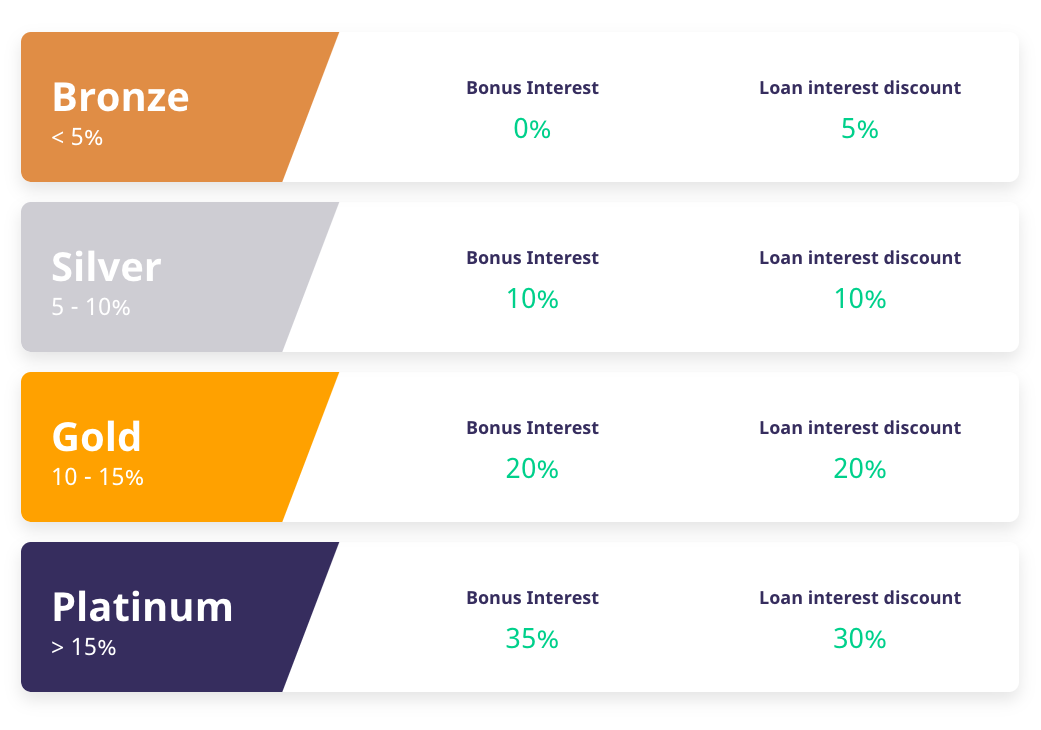
The relative amount of $CEL in your Celsius wallet will determine your membership level and thus rewards you will get as bonus interest for savings as well as rate discounts for loans. There are other benefits like VIP service to those with high $CEL ratios, $CEL balances, and “HODL ratios” (defined as $CEL balance / $CEL withdrawals) on CEL.
Read as product copy, that is a loyalty scheme. Read economically, it is a machine that pushes every user to buy and hold the platform's own token, creating structural demand for an asset the platform also controlled. Mashinsky's market-manipulation conviction was specifically about CEL: he inflated its price while quietly selling his own holdings. The tier tables we reproduced in 2020 were, in retrospect, the demand side of that trade. When a platform's best rates are reserved for people who hold its token, the token is not a perk. It is the product being sold, and the platform is the counterparty.
The rates did the recruiting
The most-read part of the original review was its mechanics, because the mechanics were genuinely attractive:
The interest rate hovers around 3-5% for classic cryptocurrencies, tokens and gold-backed coins, and 7-9% for stablecoins.To give a present example, you can borrow $1,000 at 0.7% APY if you pay interest in $CEL . With a term of 1 year, you will pay $0.58/month or close to $7 at the end of the year, plus the principal.
Nothing in those paragraphs is fraudulent on its face, which is exactly the point. The rate table was the funnel. Deposits flowed in because the numbers were real and paid weekly, right up until June 2022 when they stopped being paid at all. The sales narrative did not need to lie about the rates. It only needed to stay silent about the asset side of the balance sheet that funded them.
What a founder should watch for
The signals were visible in 2020, including to us. Unlike DeFi yield mechanisms built on visible lending and liquidity markets, Celsius did not say who was paying for the rate or against what collateral. Yield with no named counterparty is the loudest warning: the answer is usually the next depositor. A token whose main utility is boosting rates on the platform that issues it is the second. The third is the founder story standing in for an audit. Our review spent a full section on Mashinsky's "from VOIP to MOIP" framing, a genuinely great narrative that told us nothing about solvency.
There is a lesson on the other side of the table too. If you are a founder building in financial services, the Celsius pitch is a catalogue of what not to publish: numbers nobody can audit, rewards that only make sense if your token appreciates forever, and a rate that requires trust in you personally. Prosecutors read marketing as a record of representations. Write yours as if they will, because at Celsius they did.
Read Next

straight to your inbox