Understanding Custonomy product
Blockchain technology is very secure, however, the way some companies manage the keys is not.Custonomy is an institutional crypto custody solution designed to reduce the single-point-of-failure risk of traditional private key management by distributing signing authority across multiple parties using Multi-Party Computation (MPC) and its Hierarchical Threshold Signature Scheme (HTSS). Read this to understand how the HTSS approach differs from multi-sig, what governance controls enterprises can configure, and why Holdex partnered with Custonomy to serve crypto startups.
Holdex and Custonomy partnered to provide startups and institutions access to one of the most advanced custody technology available.
When companies deal with self-storage and private keys there are no resets, a lost key is gone forever.
Many crypto-asset hacking incidents in the past have highlighted, that the domain expertise it takes to build crypto custody solutions, and design effective governance controls, is not commonplace in the traditional financial services industry.
Different processes and assumptions are needed to design custody solutions for digital-only assets. Cryptocurrencies are created and managed using specialized technologies that come with their own unique considerations for storage and security. Users should be aware they may encounter several challenges.
Private key management problems
The management
Lost or hacked private key is always users’ biggest problems when self managed private keys, like non custodial crypto wallets. Consider the complexity of managing passwords and the frequency at which each user may have their password reset. When dealing with self-storage and private keys there are no resets, a lost key is gone forever.
Self-custody, like keeping cash in your physical wallet or locked in a drawer, poses its own risks. There is no third-party involved to manage that risk (or your funds) if you lose access to your keys, experience a destructive event like a fire or power outage, or pass away unexpectedly.
Lose autonomy
Many enterprises lack the knowledge or capability to manage their own keys, so they will choose to outsource or delegate this task to someone else who has better knowledge such as a custodian. However, by doing this, enterprises not only hand over the responsibility to third parties but also lose full control of their own assets. Using a custodian will impose limitations or dependencies that may impact the response time to the market.
Safe but inefficient
Cold wallets significantly lower the risk of unauthorized transfers through physical security and role-based control over key access. However, offline solutions are generally slower to execute on instructions because their key-storage systems can only be accessed at their physical locations.
In view of this, Custonomy provides another option in managing the key thanks to its proprietary key management solution by allowing enterprises to co-manage their keys with multiple parties, both internal and external. With this new way, enterprises can manage their keys as well as enjoy the governance processes that are imposed by third-party custodians and retain their autonomy.
Custonomy features
Custonomy provides a self-managed wallet that offers institutional control and protection features:
- Framework agnostic
- Multi-party computation (MPC)
- Multi-assets support
- Autonomy
Framework agnostic
Custonomy is designed to help enterprises meet regulatory requirements and anticipate future compliance changes. With Customony it is easy to scale and stay relevant when embracing innovation.
Multi-party computation technology (MPC)
Custonomy enables users to secure their crypto assets with flexibility by removing the single reconstructed private key. Thanks to its MPC technology. Custonomy and its users independently generate key shards that will be used for transaction signing. The private key is never reconstructed in one place, which is designed to remove the single point of compromise.
Multi-assets support
Custonomy can support all kinds of assets (cryptocurrencies and NFTs) and all chains with ECDSA and EdDSA signature standards: Bitcoin ($BTC ), Bitcoin Cash ($BCH ), Ethereum ($ETH ), Binance Smart Chain, Solana ($SOL ), Filecoin ($FIL ), and major EVM chains.
Autonomy
Custonomy is designed to give users autonomy while keeping strong security controls in place. The solution comprises an authorization workflow engine that allows users to define different levels of policy, for example, address-, transaction-, time- or user-based rules.
Product Features
The most notable feature is the unique, MPC threshold key management scheme. Based on the Hierarchical Threshold Signature Scheme (HTSS), Custonomy has developed a threshold key management scheme that allows multiple tiers of threshold signing authorities, which Custonomy describes as a first of its kind. The multi-layer Threshold Scheme controls a set or a particular secret share that is mandatory and cannot be bypassed. All these desired properties are embedded mathematically in the cryptography of the MPC protocol. That makes this key management solution flexible for different use cases.
Custonomy positions HTSS as addressing the main requirements enterprises raise. The concept originated from academic research which studied the problem of threshold secret sharing in groups with a hierarchical structure. The main principle is that the secret is shared among a group of participants and partitioned into levels to work against a single address virtually.
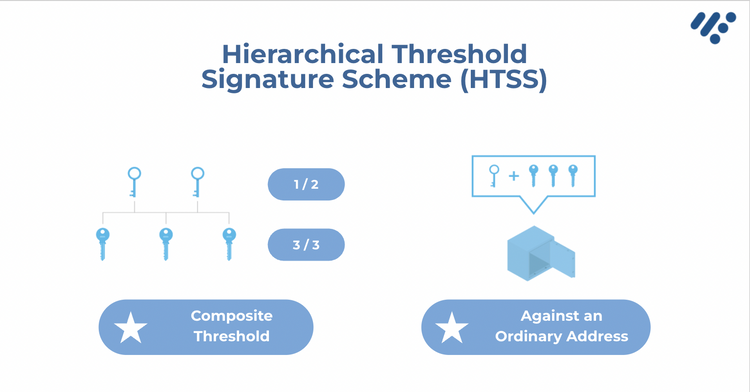
Another flexibility offered by HTSS is the possibility to enable systems to have signing power to process the transaction. For example in the second level of the scheme, signing power is given to KYC, AML, and Anti-Fraud. Custonomy says this makes transactions more automated and easier to keep compliant. There are several levels in the signing scheme based on a company’s needs. And the threshold for each level can be customized by an enterprise.
To sum up, Custonomy’s HTSS lets an enterprise add a tier of regulatory nodes as mandatory, which Custonomy says helps enforce compliance on transactions. And the beauty is that everything can work natively as a usual address in the public chain. Unlike multi-sig, Custonomy’s solution doesn’t leave any footprint of the policy and signing rules in the blockchain. Lastly, Custonomy says threshold signing makes fraudulent key usage much harder, addressing one of the central problems of crypto protection. This solution provides a strong key-management platform and changes how an enterprise complies with crypto regulations, by just using the key. It works through the cryptographic protocol itself, without add-ons or plug-ins.
Custonomy team
Founding Team
- Keith Hung - CEO & Co-founder
- Raymond Lam - Chief Engineer & Co-founder
- Annie Hui - COO & Co-founder
- Calvin Choy - CSO & Co-founder
Investors
Note that Babel Finance collapsed in 2022 after suspending withdrawals and entering restructuring.
Partnership with Custonomy
Holdex partnered with Custonomy to serve crypto startups and project owners, pairing Holdex's advisory and accelerator work with Custonomy's MPC key-management solution. At the time, both teams framed it around a shared value-first approach and a real asset-management problem worth solving.
We are really proud of this partnership and we believe we can bring more value to the ecosystem by leveraging our synergies with Holdex – said Keith Hung, Co-Founder and CEO of Custonomy.
Read Next


straight to your inbox