Understanding Swerve: a beginner’s guide and review
What the cleanest fair-launch experiment of DeFi summer proved about forks, teams, and staying power.If you've watched a vampire fork drain liquidity from an established protocol and wondered whether community ownership alone can keep one alive, this retrospective of Swerve Finance has the answer. You'll learn why the fair-launch critique of VC token allocations still holds up, how an abandoned protocol turned into a $1.3M governance attack in 2023, and what forks actually compete on once their emissions run out.
This article is a substantial revision of our September 2020 review of Swerve Finance, published when the protocol held hundreds of millions in deposits and looked like a credible challenger to Curve. Swerve went dormant within months, was abandoned by 2021, and in 2023 its leftover governance was attacked for $1.3M. We have rewritten the piece as a lessons-learned retrospective, quoting the original review against what actually happened. It is not a recommendation or investment advice.
Swerve matters because it was the cleanest natural experiment the fair-launch era ever ran. It forked Curve's code without modification and changed a single variable: who owned the tokens. No VC allocation, no pre-mine, no team share, no ICO. If community ownership alone could sustain a protocol, Swerve was the project built to prove it. It proved the opposite, and how it failed teaches more than most successes.
What we reviewed in 2020
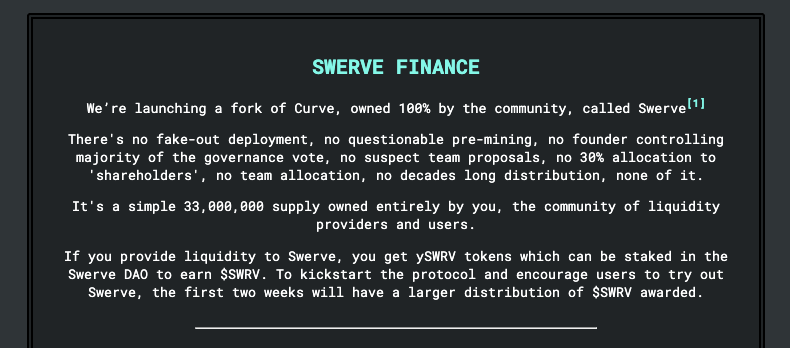
Swerve launched in September 2020 as a fork of Curve, the established stablecoin DEX, built by a pseudonymous developer going by "John Deere". The mechanism was identical to Curve's: an automated market maker tuned for hard-pegged assets, offering very low slippage and low fees on a single pool of $USDT , $USDC , $DAI , and $TUSD . The difference was ownership. All 33M $SWRV governance tokens were to be distributed to liquidity providers, with nothing reserved for a team or investors.
The launch itself worked. As we wrote at the time:
A total of 33M governance tokens called $SWRV were minted, and 9M were distributed in the first two weeks, with Swerve reaching $400M in total value locked (TVL), and $SWRV passing $1B in market capitalization.
The fair-launch argument
The strongest writing in our original review was not about Swerve at all. It was about who deserves to own a protocol, and the argument still holds up. On why liquidity providers claimed the moral high ground:
LPs argue they take the most risk, often taking a chance on unaudited smart contracts to power low-liquidity markets that are volatile and often targets of manipulation tactics.
On how many teams and their investors behaved instead:
Many teams and VCs in DeFi have sidestepped these realities and sold or reserved a big chunk of their governance tokens to themselves, sometimes with vesting schedules and capitalization tables that mimic traditional VC startup funding.
John Deere made the same case by listing everything Swerve refused to do:
There's no fake-out deployment, no questionable pre-mining, no founder controlling majority of the governance vote, no suspect team proposals, no 30% allocation to 'shareholders', no team allocation, no decades long distribution, none of it.
We still think the critique was fair. Cap-table economics grafted onto protocols nobody can own is a real tension, and the industry never fully resolved it. Where Swerve went wrong was the conclusion it drew: that removing the team's allocation removes the need for a team.
What the experiment proved
Our original review rested on the founder's core belief:
John Deere is convinced that a community-governed protocol will be more resilient in the long-run.
Resilience is exactly what Swerve did not get. The decay was visible even as we wrote: TVL had already fallen more than 90% from its $700M peak once emissions dropped and yield farmers, in the original's words, "went to chase for rewards elsewhere". The liquidity was never loyalty. It was rented with $SWRV emissions, and it left the moment a better rate appeared elsewhere. By 2021 the project was abandoned outright: nobody was paid to maintain it, so nobody did. Development stopped, the community dispersed, and the contracts kept running unattended.
Curve, the protocol Swerve set out to out-legitimize, kept shipping. The team allocation the fork existed to reject was also, in practice, the budget that kept people showing up to work.
The postscript arrived in March 2023. An attacker spent weeks accumulating voting power in the abandoned DAO and moved to seize ownership of the protocol's contracts, targeting roughly $1.3M still sitting in its pools. The Block covered the attack while it was live, and Halborn published a technical breakdown. The vulnerability was not a flaw in Curve's battle-tested code. It was the absence of anyone whose job was to watch. A fully distributed, fully abandoned governance token is an open invitation: whoever bothers to accumulate it controls whatever is left inside.
What we take from it
Swerve gave the fair-launch thesis its best possible test: a proven mechanism, a real community, a clean distribution, no scandal. It still died, and the lessons generalize.
A fork with no team is not resilient; it is orphaned. Code does not maintain itself and integrations do not negotiate themselves, and the 2023 attack showed that even abandonment has a cost when value is left behind.
Vampire forks compete on emissions, and emissions are the one advantage that cannot last. At its peak Swerve drew three times more volume per dollar locked than Curve, and none of it stayed, because nothing held it there once rewards fell.
Token distribution decides who captures the upside, not whether anyone shows up to work. The fair-launch movement answered a legitimacy question and mistook it for the sustainability question. When we help founders design token models, this is the Swerve test we apply: once the incentives decay, whose job is it to keep the thing alive? For the other way a DeFi experiment can end, read our companion retrospective on mStable's negotiated wind-down.
Read Next


straight to your inbox