Understanding mStable: a beginner’s guide and review
What the meta-stablecoin experiment taught, and how a DeFi protocol ends on purpose.If you've held several stablecoins to hedge against any one of them failing and wondered whether a protocol could package that diversification into a single safer asset, this retrospective of mStable has the answer. You'll learn why minting a meta-stablecoin lost to simply holding the winning stablecoins, how a backer list featuring Alameda and Three Arrows inverted from credential to warning, and what an orderly DeFi wind-down looks like next to a collapse.
This article is a substantial revision of our September 2020 review of mStable, written when the protocol was a top-20 DeFi project by value locked. In 2023 mStable's governance voted to be acquired by dHEDGE, and its core products, including mUSD and Save, were wound down. We have rewritten the piece as a lessons-learned retrospective, quoting the original review against what actually happened. It is not a recommendation or investment advice.
mStable ran what we would call the meta-stablecoin experiment. Instead of asking users to pick a winner among $USDT , $USDC , $DAI , and $TUSD , it accepted any of them into a basket and minted one asset, $mUSD, against the lot. The experiment ended not with a depeg or a hack but with a governance vote and a negotiated exit, which makes it doubly instructive: the thesis failed, and the ending was handled well.
The pitch we reviewed in 2020
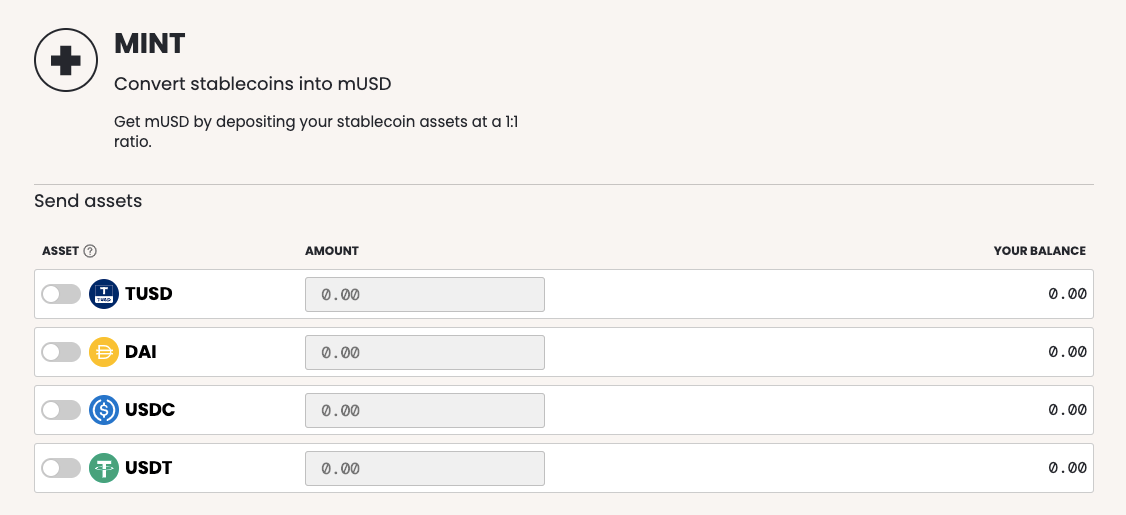
Deposit any supported stablecoin (a bASSET, in mStable's vocabulary) and the protocol minted $mUSD against it at a 1:1 ratio. The safety argument was diversification:
The thinking goes, since one $mUSD is not backed by a single protocol or provider, holding $mUSD as a whole is safer than holding any one particular bASSET.
On top of minting sat Save, which paid yield on $mUSD by lending the underlying assets through Compound and Aave, plus trading fees from the platform's swap function.
The explainer that still teaches
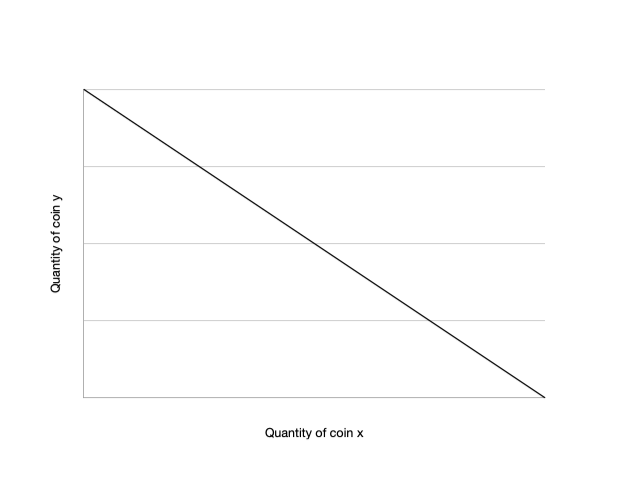
One part of the original review we would republish unchanged is the swap
mechanism.
An AMM like
Uniswap
prices trades along a constant-product curve, x * y = k, so every trade moves
the price and large trades pay slippage. mStable used a constant-sum formula,
x + y = k, under which the price between two assets is always exactly 1:1 and
slippage is zero.
That is the right model for assets that are supposed to be interchangeable,
and it is why the design needed guardrails: at a fixed price,
a depegging stablecoin would otherwise be dumped into the basket without limit.
As the original explained:
In order to protect the system, however, each basket has a set of maximum weights per bASSET, and no swaps, minting, or redemptions are allowed if it would cause any bASSET to exceed its maximum weight as a result.
The trade-off generalizes to any venue for pegged assets: fixed pricing gives users the best execution and gives the system no price signal to defend itself with, so the defense has to be quantity limits instead. Our original review even flagged the early symptom, a basket that kept filling up with whichever bASSET was trading below its peg.
The credential that inverted
Our original legitimacy section leaned on the backer list:
The project’s team, Stability Labs, has received the backing of Alameda Research, Three Arrows Capital, and others.
In 2020 those were among the strongest endorsements available in the space. By the end of 2022 both had collapsed, Three Arrows in liquidation and Alameda inside the FTX bankruptcy. The point is not that mStable was implicated; it was not. The point is that we, like most reviewers of that era, treated a backer list as evidence of quality, and that evidence can invert without the protocol changing at all. A mechanism can be verified. A credential is only borrowed.
The insurance that was never tested
$MTA , the protocol's governance token, was pitched as its backstop:
Should a bASSET fail, the system would be under-collateralized, and $MTA would be issued and sold until the system is re-collateralized. The exact mechanics of this insurance have not yet been launched but are expected in the next phase of mStable’s development.
That mechanism was never meaningfully tested. No bASSET failure ever forced it to fire, so the hard question went unanswered: whether minting and selling a governance token into the middle of the exact crisis that made the sale necessary could raise enough to recollateralize the basket. Token-as-insurance designs keep reappearing in DeFi, and the honest reading of mStable's three years of operation is that they produced no evidence either way. Founders designing a similar backstop should assume it remains unproven until the worst day, which is the worst possible time to find out.
Why it wound down, and how
The deeper problem was the value proposition. Holding $mUSD meant accepting mStable's smart contract risk plus the risk of every stablecoin in the basket, including the weakest, in exchange for diversification across assets anyone could simply hold directly. As the market consolidated around a few clear winners, holding the winners beat holding a minted claim on all of them, and the basket's habit of filling with the least-wanted asset made the comparison worse. The Save yield came from Compound and Aave anyway; users could go to the source. Aggregation has to beat the underlying by more than the risk it adds, and $mUSD never durably did.
To its credit, the community read the same conclusion and acted on it. In early 2023 mStable governance passed MIP-33, a proposal for the protocol to be acquired by dHEDGE, and token holders approved the deal. The acquisition completed in April 2023; $mUSD and Save were wound down, and the treasury arrangement gave $MTA holders an exit at a floor of roughly $0.0318 per token.
Compare that to how DeFi projects usually end: an exploit, a depeg, a frozen front end, a Discord gone quiet. mStable's ending had a written proposal, a public vote, a negotiated price, and a defined exit for token holders. It is the closest thing the industry has produced to an orderly dissolution, and it happened because governance stayed functional enough to choose an ending rather than drift into one.
Two lessons, then. The product lesson is that packaging other people's assets is a business only when the package earns more than it risks; diversification alone was not a product. The operational lesson matters more to the founders we work with: how a venture ends is a design decision. mStable's token holders and users got a cleaner outcome than the market default, not because the thesis worked, but because someone wrote MIP-33 instead of walking away. Swerve, covered in another retrospective in this series, shows the walking-away version, and the two endings are worth reading side by side.
Read Next


straight to your inbox