Understanding Aave: a beginner’s guide and review
This article is a guide to the history and fundamentals behind Aave, from the ETHLend days to the v4 hub-and-spoke era. We cover the team and technology behind the project, its vision, its market maturity, and the state of its ecosystem.If you've borrowed or lent on Aave and wondered how a P2P lending experiment from 2017 became DeFi's largest protocol, this guide has the answer. You'll learn how pool-based lending, aTokens, and flash loans actually work, how the LEND to AAVE migration and Safety Module reshaped the tokenomics, and where the protocol stands in 2026 with GHO and the v4 hub-and-spoke launch.
TL;DR: You can get a summary of this article on its last section
Aave (formerly ETHLend) is an open-source, non-custodial, decentralized lending protocol running on Ethereum and more than a dozen other networks, including Arbitrum, Avalanche, Base, Optimism and Polygon (earlier deployments on Fantom and Harmony were frozen in 2022). Currently, it is the largest DeFi protocol by both value locked and outstanding loans. It has also pioneered several DeFi functions like flash loans and unsecured borrowing.
This article is a guide to the history and fundamentals behind Aave. We will cover the team and technology behind the project, its vision, as well as its market maturity and the state of its ecosystem.
In presenting this guide and review of Aave, I will divide my analysis into 5 sections, each containing a salient feature of the project, as follows:
- Legitimacy
- Purpose
- Tokenomics
- Ecosystem
- Summary
Legitimacy
Aave was founded in 2017 by Stani Kulechov, a Finnish enthusiast of coding and financial instruments, and a trained lawyer.

Kulechov founded Aave as ETHLend in Tallinn, Estonia. In late 2017, an ICO based on the ETHLend Whitepaper which originally detailed a peer-to-peer (P2P) lending protocol for Ethereum. The ICO raised $17.8M which was followed by $3M in venture funding where Framework Ventures and Three Arrows Capital bought $LEND tokens from the treasury. The latest round is to be used to make the protocol more decentralized and revamp the tokenomics to better align incentives in the ecosystem as well as strengthen protections to users. In October 2020, the protocol migrated to a new token with the symbol $AAVE at a rate of 100 $LEND : 1 $AAVE .
Aave launched on the Ethereum mainnet in January 2020. By May 2020, it had $65M in locked value. Flash loans were launched and got to $15M by June 2020. Within a year of launch, Aave had billions in locked funds and hundreds of millions in issued flash loans, outpacing Maker Protocol as the dominant DeFi protocol. It has held the no.1 spot in DeFi lending ever since, with total value locked peaking above $30B ( Aave’s 2025 recap).
In July 2020, Aave received an electronic money institution (EMI) license by the UK’s Financial Conduct Authority (FCA).
Purpose
Aave was created to facilitate transparent and open infrastructure for decentralized finance. Kulechov recounts that when the token first launched, the idea of DeFi, despite its simplicity, was completely foreign to the community. People asked why they would give their precious cryptocurrency as collateral. After all, Aave was the first lending application on Ethereum. There were no stablecoins and no DEXs, and besides not understanding core concepts like the need for over-collateralization, people didn’t see the use case of lending their assets. Then, things started to change with the appearance of $DAI , $USDC , and much-maligned pioneer of the DEX model, EtherDelta.
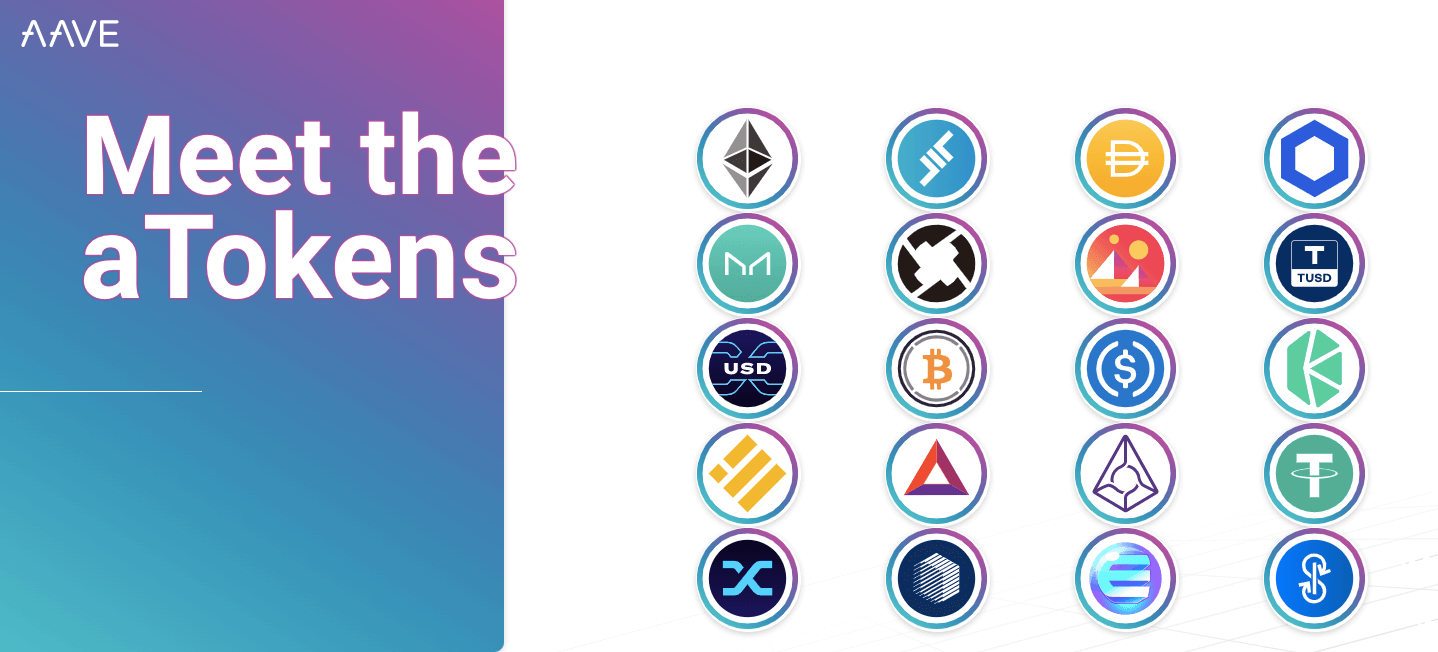
Aave moved from the P2P lending model to a pool-based model. By developing a number of algorithms to determine the interest rate to pay in pools for savers or liquidity providers (LPs) and the ratio of collateral or loan-to-value (LTV) ratio required for each asset, the system works without a mediating third party. Anyone can participate and there are no KYC checks. There is a pool for each asset listed in Aave (19 at the original time of writing; far more today across its markets). A user that deposits an asset in one of Aave’s smart contracts receives an Aave interest-bearing token (aToken) e.g. a user who deposits $DAI will receive aDAI which is minted at the moment of deposit and will be burnt when the user redeems his $DAI . While the underlying assets of a pool can be borrowed, interest is accrued on the aToken, whose balance users can see grow on their wallets every minute. One can freely store, transfer, and trade aTokens, their value pegged 1:1 to their underlying asset.
Upon this basic architecture, Aave built other functions like flash loans — which are zero-collateral loans that need to be repaid within one transaction block for use cases like arbitrage, collateral swapping, and self-liquidation — and the choice of stable rates if assets are held until maturity, which makes for a lower perceived risk and better user experience.
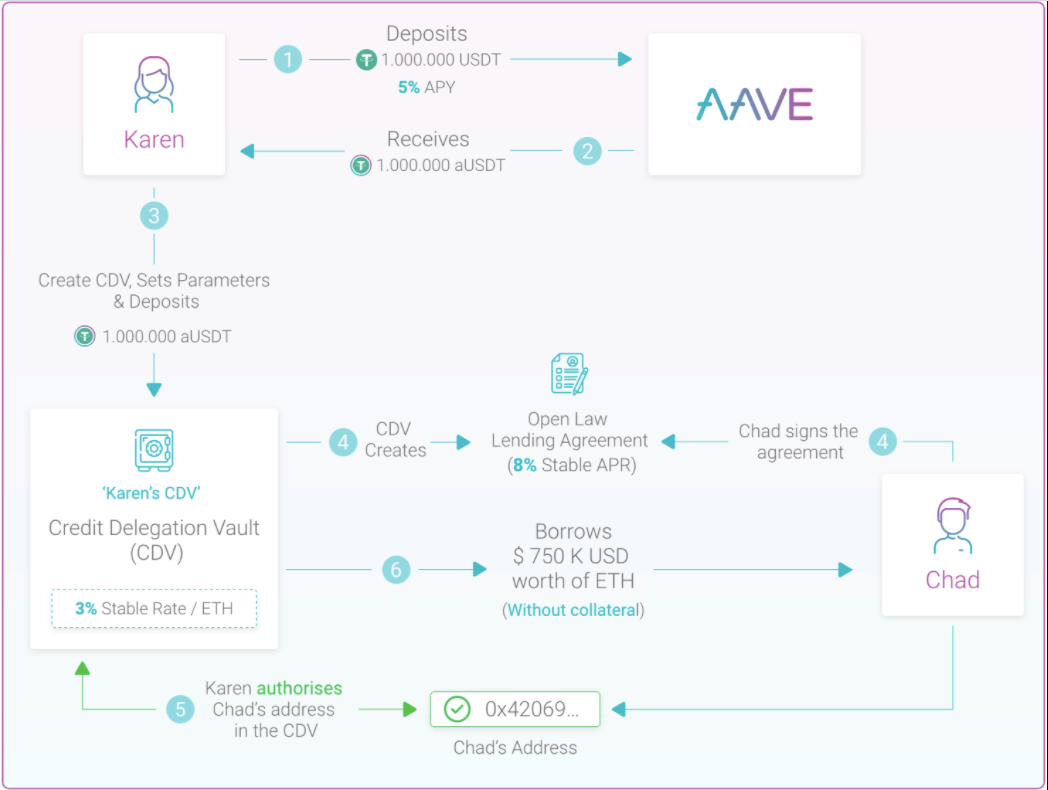
The success and innovations that Aave has brought to the DeFi sector are due in large part with Kulechov’s obsession with composability, a principle of design as applied to systems or design thinking, whereby a highly composable system is one where components can be assembled in many combinations to satisfy specific user requirements. We can see for example how Aave inherited the $LEND token from its ETHLend days but was able to repurpose this component as a governance token, becoming a pioneer amongst lending protocols and creating a better system where more combinations (i.e. more use cases) are now possible. A case in point is the launch in Aave of credit delegation, shortly after flash loans, allowing users to lend their aTokens through the creation of a vault and an OpenLaw agreement containing terms like the desired interest rate and amount of capital that can be borrowed. Aave’s focus on composability goes beyond its internal systems and targets the role that Aave can play in the composability of the entire DeFi ecosystem.
Tokenomics
In 2020, Aave went through a major protocol overhaul to implement next-generation governance and economic rights in its token model, migrating the $LEND token into a new denomination called $AAVE . The process was detailed in the Aavenomics paper. The overhaul introduced a staking mechanism called the Safety Module (SM), which provides insurance against shortfall events i.e. when there is insufficient collateral in a given pool and collateral-of-last-resort is needed. Stakers are rewarded with $AAVE tokens as Safety Incentives (SI) and a cut of protocol fees. Another pool on the Safety Module staked $ETH through an AAVE/ETH pair on Balancer earning $BAL along with trading fees.
As part of the migration, Aave reserved almost 20% of the supply of the new tokens for a fund for creating protocol incentives and upgrades. The administration of the incentives is decided by the community. The community votes Aave Improvement Proposals (AIPs) on-chain with their $AAVE tokens to decide on implementation details. More details can be found on the Aave governance forum. Altogether, these changes repositioned AAVE as a utility with both economic and governance rights, which is pretty close to traditional equity stock, except for the major difference that it serves a decentralized protocol.
The migration completed in October 2020: 100 $LEND became 1 $AAVE at the genesis governance vote, and $AAVE has functioned as the protocol’s governance token ever since.
$AAVE is traded in secondary markets.
$AAVE is an ERC-20 token so it can be stored on any Ethereum wallet that supports custom contracts like MetaMask. Other wallets like Pillar, Trust Wallet and Ledger are also great options.
Ecosystem
Aave is developing a strong ecosystem of integrations, partnerships, and collaborations, driven by a community-centric approach as exemplified in its roadmap and governance proposals.
Moreover, Aave has been public about its relocation to London and its support of the city’s FinTech and dApp ecosystems. Aave is still in many ways a company catering to developers. Aave was a sponsor of ETHLondon 2020, the first ETHGlobal event held in the United Kingdom.
Aave Ecosystem Reserve
In accordance with Aavenomics, Ecosystem Incentives (EI) are, together with SI, the mechanisms by which the protocol rewards those bearing the most risk to provide safety and liquidity. Applications built on top of the Aave protocol may be allocated rewards by the community through decentralized governance.
In order to capitalize on this initiative, an Ecosystem Reserve will be set up on the genesis governance vote. The reserve will have 3M AAVE which is equivalent to 300M LEND or $225M at today’s prices. Whether the reserve gets replenished or not will depend on the Protocol Policies adopted by the community.
In the meantime, Ecosystem Grants are being given under a more centralized approach. Round 1 was concluded and Round 2 is ongoing.
Development Roadmap
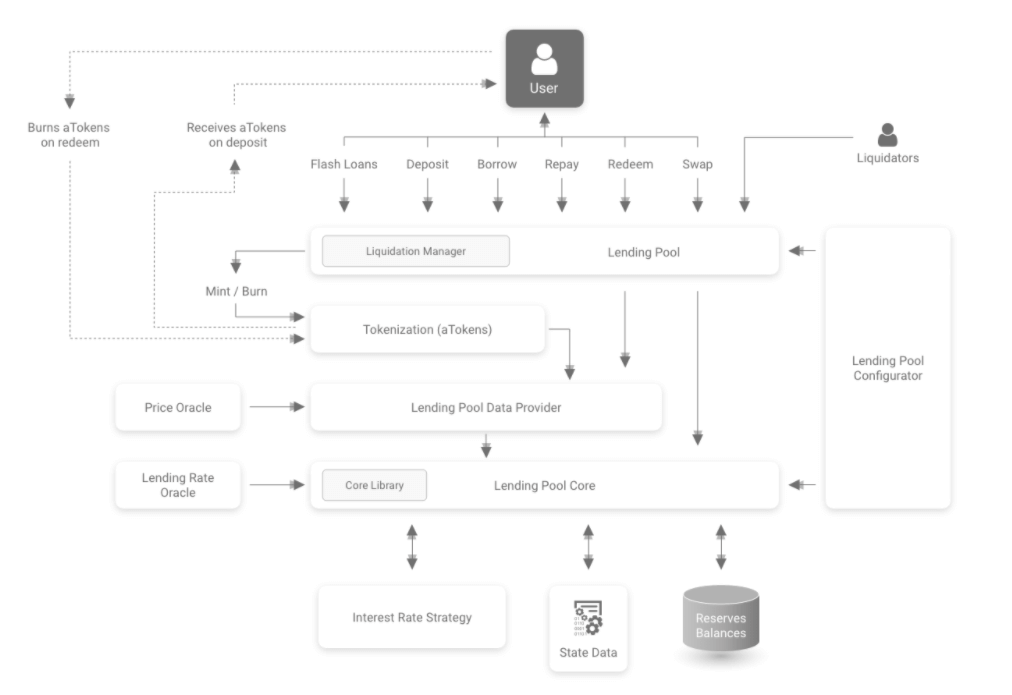
Aave is fully open source and audited, and provides well-explained documentation on the Aave Developer Docs on the working of the protocol, its architecture, smart contracts, security and audits, and integration guide. All the source code can be found on the Aave protocol’s GitHub repository.
The roadmap this review once described as "coming" has long since shipped. Aave v2 landed in December 2020 with debt tokenization, gasless aToken approvals, and repaying with collateral; Aave v3 followed (on L2s in 2022, on Ethereum in 2023) with cross-chain Portals, Efficiency and Isolation modes, and large gas savings. On-chain governance with vote delegation went live, and liquidity-mining incentives came and went as a bootstrapping phase rather than a permanent feature.
Two later additions define where Aave sits in 2026. GHO, the protocol's own overcollateralized, decentralized stablecoin, launched on Ethereum in July 2023 and is minted directly against Aave collateral ( Aave 2025 recap). And Aave v4, now live on Ethereum ( launch announcement), moves the protocol to a hub-and-spoke design: individual markets ("spokes") draw liquidity from a shared hub, so markets on the same chain consolidate instead of each running a separate pool. The unification is per hub, not global: liquidity is shared only among the spokes on a given hub, and each network has its own hub, sometimes more than one ( architecture explainer).
Clearly, the Aavengineers have been hard at work.
Community Partnerships
Aave’s success is in no small part anchored in its usage, climbing to over $1B in total value locked (TVL) in less than 6 months. Aave attentively listens to its community members, which it calls Aavengers, in implementing improvements to the protocol.
From a strategic point-of-view, Aave intends to become middleware for the financial infrastructure of the future, and as such other protocols and service providers ought to see Aave as an integral part of their product or service architectures. Wallets like Pillar, Argent, and DeBank integrate Aave to offer savings and/or loans natively to their users, while automatic yield rebalances like Totle use Aave as a liquidity provider.
In Summary
Not by coincidence, Aave has surpassed much larger incumbents to become the no.1 DeFi protocol in the Crypto-Verse. Its penchant for innovation and its solid principles in design and engineering have brought not only product-market fit on a highly volatile Ethereum dApp landscape but accelerated growth through continued value-added features.
Excited about Aave? Anything this article missed? Reply below to let me know!
Read Next


straight to your inbox