Understanding SushiSwap: a beginner’s guide and review
Beginner's guide to SushiSwap: the vampire-mining launch, the Chef Nomi saga, and where the protocol stands in 2026.If you've watched a fork drain liquidity from an established protocol and wondered whether vampire mining can build something durable, SushiSwap's six-year story has the answer. You'll learn how the 2020 launch and Chef Nomi's $14M withdrawal played out, how the protocol outlived the downfall of its rescuer Sam Bankman-Fried, and where Sushi stands in 2026 under Sushi Labs and new leadership.
SushiSwap or Sushi is a decentralized exchange (DEX) that was created as an “evolution of Uniswap ” by introducing a governance token to provide additional rewards to liquidity providers (LPs). SushiSwap’s launch and the antics of its pseudonymous founder grabbed most headlines in the Crypto-Verse in the late summer of 2020, and the protocol’s history since has been just as eventful.
In this article, we will be taking an introductory look at Sushi in order to better understand its functioning and industry impact. In this analysis of Sushi, 6 different sections will be covered, as follows:
- Legitimacy
- Purpose
- Tokenomics
- Ecosystem
- The road to 2026
- Summary.
Legitimacy
SushiSwap was conceived by Chef Nomi, a pseudonymous character who created a Twitter and a GitHub account in late August 2020, presumably to protect his identity, but evidently also to enhance the branding of his food-themed decentralized finance (DeFi) protocol.
Chef Nomi presented himself as a full-stack blockchain developer, capable not only of forking the Uniswap automated market maker (AMM) codebase to power the SushiSwap DEX, but of modifying it to introduce a governance token called $SUSHI and the rewards logic. Nomi also introduced a Yam Finance-inspired UI, forked from the Yam codebase. Finally, Nomi also introduced the migration contracts.
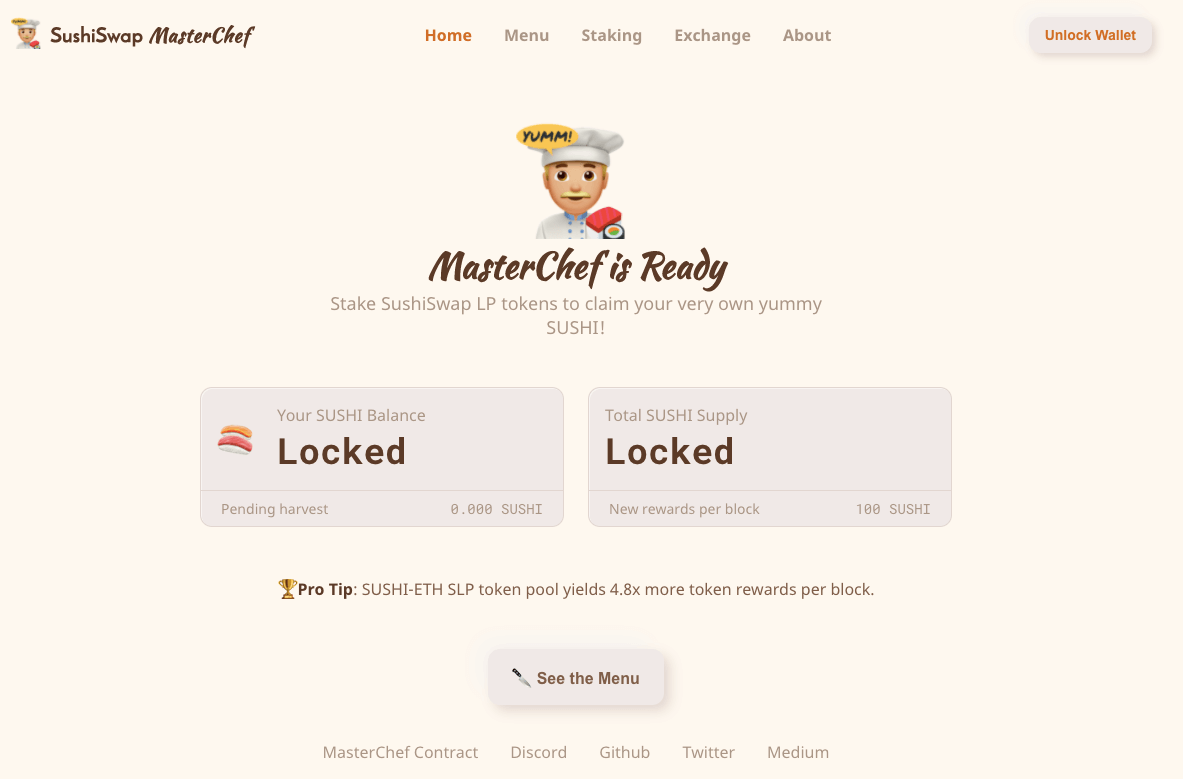
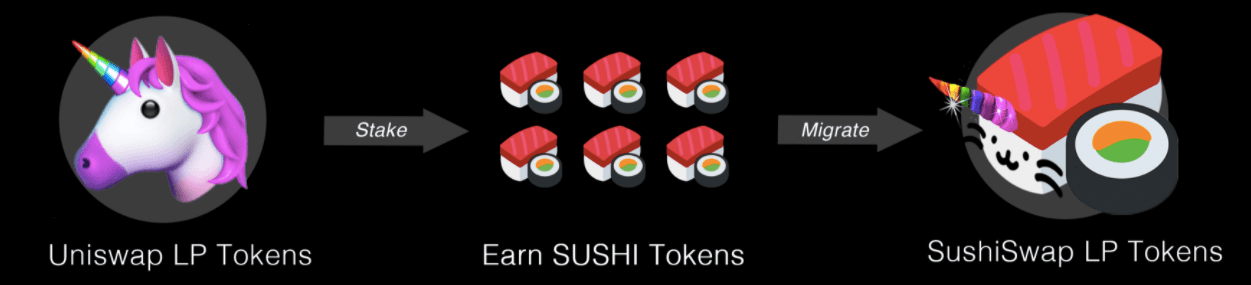
The SushiSwap announcement on Medium provided the gist of how the platform was to launch and operate initially. SushiSwap would introduce rewards in $SUSHI , a devfund or ecosystem fund for development, and a launch via liquidity migration from Uniswap, a first in the industry that would later by others described as vampire mining as it incentivized existing Uniswap LPs to stake their LP tokens in SushiSwap contracts by giving them $SUSHI .
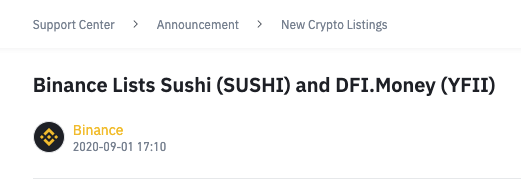
The SushiSwap code was then audited by Quantstamp, which found no critical or major issues. The project then received a massive boost, at some point an estimated 79% of total value locked (TVL) in Uniswap was attributed to one of the 13 pools whose LP tokens had been locked with SushiSwap to receive $SUSHI , especially in the $SUSHI –$ETH pool that was paying 2x rewards, on top of the 10x rewards being paid for the first two weeks of the launch. In a wild day, Binance listed the token, causing early $SUSHI investors to go 3x.
Cryptonauts thought they had already been getting quite the saga, with the community torn over the morals of vampire mining. On one side, Uniswap ’s founder Hayden Adams publicly admonished Chef Nomi as an opportunist; on the other, FTX CEO Sam Bankman-Fried (SBF), then one of the most trusted names in the industry, made a personal bet on the platform and farmed a lot of $SUSHI . However, that had just been the preamble. On September 5, Chef Nomi reneged on his promises and withdrew 2.5M $SUSHI (18,000 $ETH ) and 20,000 $ETH , or $14M in total, from the liquidity pool, admittedly to cash out. As the news hit the Crypto-Verse, the $SUSHI price collapsed, which had been falling with the rest of the market, took a dive and bottomed at -90% for the week. Nomi faced accusations of running off with funds, which he denied. As prominent Crypto-lawyer Preston Byrne advised victims to sue and recover their losses from Nomi, the Chef decided to hand over the admin keys of the protocol to Sam Bankman-Fried, to set up a multisig board of governance, and complete the migration. A week later, Chef Nomi returned the 38,000 $ETH to the multisig treasury, for the community to decide what to do with it.
Purpose Functionality
The purpose of SushiSwap is to improve on the AMM model made popular by Uniswap by introducing a token with revenue-sharing and network effects, as well as community governance.
Exchanging works exactly like in Uniswap. Anyone can create a pool by adding any two ERC-20 tokens, the price will then be implied. Others may provide liquidity to an existing pool by adding tokens at the same rate as the in-pool proportion or implied exchange. Traders change the balance of assets in the pool, as they add and withdraw at prices according to its constant product market maker algorithm of x * y = k. LPs get LP tokens when adding liquidity, a sort of receipt, that they can redeem for the assets in the pool, at the prevailing rate. This may cause an impermanent loss, as the assets will not be in the proportion deposited, and may be worth less in aggregate than if they had just been held.
People can participate in SushiSwap by providing liquidity and earning market-making fees, which in SushiSwap’s case are currently 0.25% of each transaction. The other 0.05% of the fees are converted into $SUSHI and given to staked $SUSHI holders. This split was suspended between 2022 and January 2024, when governance redirected all fee revenue to the treasury under a program called Kanpai to keep the project funded through the bear market, before restoring the original split.
Tokenomics
$SUSHI is the governance token of Sushi protocol. Like other governance tokens, it is meant to confer both economic and voting rights over the protocol, acting in many ways as a share of stock acts over the cash flow and control of a centralized firm.
An undercurrent in the launch of SushiSwap was the opposition to “unfair”
distributions.
Albeit admirers of
Uniswap
’s core design, Chef Nomi and his followers were upset at the involvement of VCs
and the dilution of rewards for early adopters of the protocol.
These “anons” saw the introduction of $SUSHI as a way
for early adopters to be rewarded
for providing the critical liquidity in the early phase of the protocol,
as well as for participating in the governance and leading the community.
The success of $SUSHI was thus tied to the success of SushiSwap
as a grassroots effort, instead of its drawing in of “elites”.
This idea has a lot of emotional pull in the Crypto-Verse:
you don’t need to know VCs or whales,
you don’t need to know Vitalik or anyone at the Ethereum Foundation,
you don’t even need to show your face.
Just buidl, release,
and let your code and memes become so irresistible
that the community cannot help but participate.
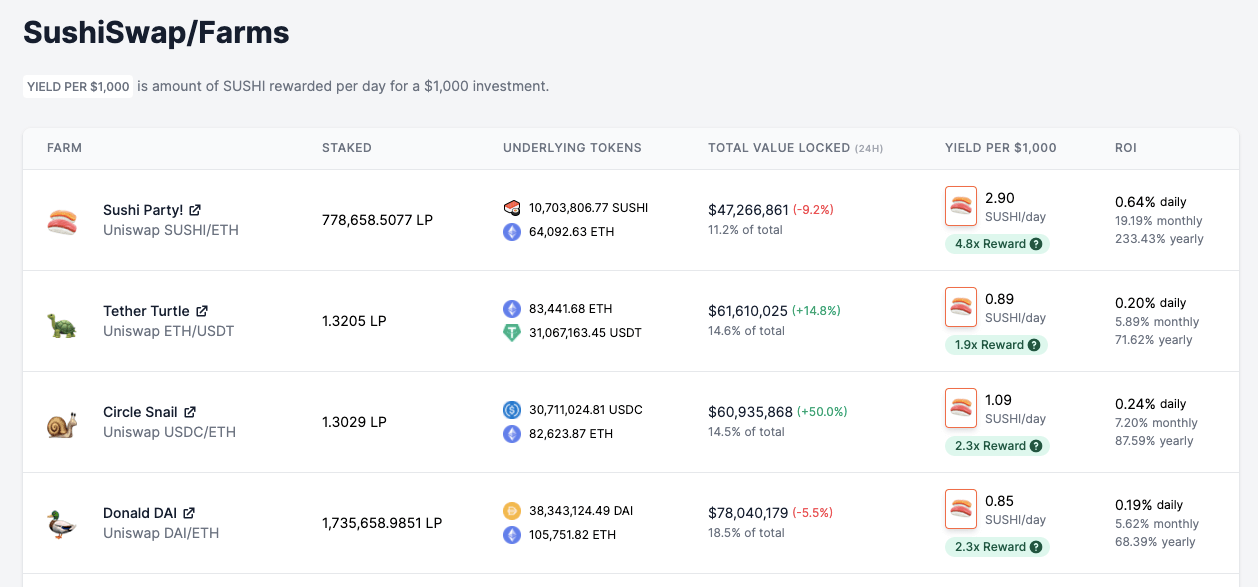
Now that SushiSwap has migrated, $SUSHI can be staked to earn its portion of the 0.05% of all trading fees. When staked, the counterparty token $xSUSHI is given in return, which represents the staked $SUSHI plus their share of the trading fees. You can provide liquidity to any SushiSwap pool and receive an SLP counterparty token. To earn $SUSHI as block rewards, you can stake your SLP tokens on the Sushi “farms”.
$SUSHI is traded in secondary markets.
$SUSHI is an ERC-20 token, so it can be stored in any ERC20 compatible wallet that accepts custom contracts like MetaMask, Trust Wallet, Ledger, Pillar, or Portis.
Ecosystem
Sushi governance is integral to its value proposition. $SUSHI holders participate in governance with an on-chain treasury and a multisig board of directors. At launch, the plan was for this to evolve into a decentralized autonomous organization (DAO) codenamed OmakaseDAO; governance did eventually formalize into a DAO, though under a different structure (more on that in the road to 2026 below).
DevFund | Sustainability Fund
Supposedly done after a suggestion by Larry Cermak, director of research for The Block, a tenth of every $SUSHI distribution is going to a development fund from where a core dev team and grants can be allocated. This fund was called a devshare by Chef Nomi, which vigorously defended his right to control such funds, which at some point had $27M. Indeed, it was Nomi’s withdrawal of these funds that almost collapsed trust in the project.
After the rescue, this address came under the control of the multisig “board of directors” consisting of 9 signers, which was set up by SBF after Nomi handed him the admin keys to save the project.
Products | Roadmap
The new Sushiswap is available @Sushi.com/swap along with other products introduced by the Sushi team. A comprehensive documentation and guide for beginners can be found at Sushi Academy. For analytics, check Sushi’s official analytics. Sushibar to easily farm $SUSHI . sushiswap.js, a library to interact with Sushi made by user BoringCrypto.
Partnerships Community | Governance
After the migration completed, the official dev team consisted only of 0xMaki, one of the original three devs building and promoting the project. Maki managed the project on behalf of the multisig signers, who were voted by the community, until his departure in 2021.
Proposals and voting take place on Sushi’s board in Snapshot, where 1 $SUSHI entitles a member to 1 SushiPowah, a voting metric. The OmakaseDAO specs from the Medium article about the grand opening of SushiSwap were never implemented in that form; the governance structure that ultimately emerged is covered below.
The road to 2026
The years after launch rewrote much of this story’s cast. Sam Bankman-Fried, the rescuer who took the admin keys from Chef Nomi, saw his FTX empire collapse in November 2022; he was convicted of fraud in 2023 and sentenced to 25 years in prison in 2024. The man once trusted to save SushiSwap became the defining cautionary tale of the industry.
Leadership of the protocol changed hands several times. 0xMaki stepped back in 2021, and after a turbulent period of interim leads, Jared Grey was elected head chef in late 2022. In April 2024 the community approved a restructure that moved day-to-day development to a dedicated company, Sushi Labs, operating alongside the Sushi DAO. In December 2025 came another transition: Synthesis invested $3.3M and its founder Alex McCurry took over as CEO, with Grey moving to an advisory role.
The business itself has been humbled. TVL fell from a 2022 peak of around $8B to roughly $100M by late 2025, and the protocol now competes as one mid-sized multichain DEX among many rather than as Uniswap’s chief rival. Still, it survived a founder who briefly withdrew the development fund before returning it, the collapse of its rescuer, regulatory scrutiny, and a 98% drawdown, which is more than most 2020 “DeFi summer” projects can say.
In Summary
SushiSwap made it through the fog of war of a Crypto-Verse launch, and came out as an interesting project, as it introduced incentivized governance to the popular AMM model of Uniswap. The arrival of Sushi did foster competition in DeFi, pushing projects that had been slow or indifferent to introduce community governance and incentives. Whether the projects are by anon developers or not, as long as they are not scams, the Crypto-Verse as a whole can only benefit from more innovation. Six years on, Sushi is no longer the headline act, but its launch remains the canonical case study in what token incentives can bootstrap, and what they cannot sustain.
Read Next


straight to your inbox