ShapeShift exchange: a beginner’s guide and review
A beginner's guide to ShapeShift, from Swiss exchange to self-custody DAO, and the FOX tokenIf you've wondered what happened to the exchange that fought KYC on principle, lost 95% of its users when regulators forced it to comply, then dissolved its own corporate structure to escape the requirement, this review tells the whole arc. You'll learn how ShapeShift's self-custody model works, how the platform became a KYC-free DAO governed by FOX holders in 2021, and what the 2024 SEC settlement closed out from its corporate past.
ShapeShift is a cryptocurrency exchange founded in Switzerland in 2014. Since July 2021 it has been run not by a company but by a decentralized autonomous organization (DAO) governed by holders of the $FOX token, operating as a KYC-free, self-custody trading interface across multiple chains. The platform is available via Web and mobile app on iOS and Android.
Support runs through the DAO’s community channels rather than a corporate help desk, and user reviews on Trustpilot reflect both eras of the platform.
In presenting this beginner’s guide and review of ShapeShift, I will divide my analysis into 5 sections, each containing a salient feature of the service, as follows:
- Legitimacy
- Security and trading
- FOX tokens
- KYC/AML
- Summary.
Legitimacy
ShapeShift was founded in 2014 in Switzerland by Erik Voorhees, an American entrepreneur who was amongst the first wave of founders of Crypto startups. Voorhees has been an early vocal supporter of Bitcoin. Voorhees had previously founded SatoshiDICE, a Crypto gambling site which he sold in 2013, and Coinapult, a Bitcoin broker and market maker.
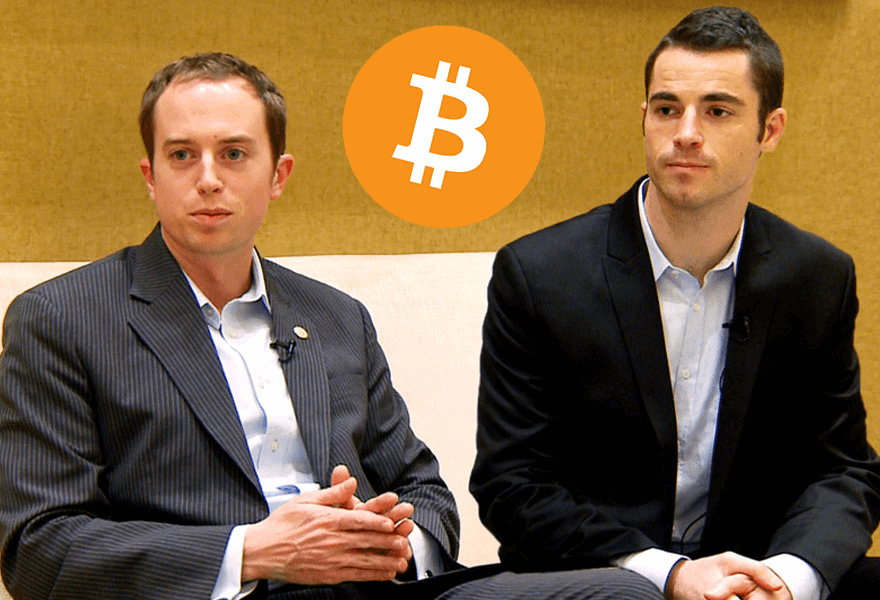
In 2015, ShapeShift received a $525k seed-stage investment from Roger Ver, the original “Bitcoin Jesus” and an early investor in Bitcoin startups, and Barry Silbert, founder CEO of the Digital Currency Group. Later that year, a second seed of $1.6M was joined by the same investors, together with Bitfinex and Bitcoin Capital. In 2017, ShapeShift raised a $10.4M Series A from Earlybird Venture Capital, joined by Lakestar, Access Ventures, Pantera Capital, and Blockchain Capital.
ShapeShift has stuck through the ups and downs of the Crypto market, and its own calamities (suffering a major hack in 2016) as well as bad press from being a long-time opponent of mandatory KYC checks. In 2019, the platform began a rebrand to much fanfare, with an optimised user experience, a B2C self-custody solution, more seamless integrations with its subsidiaries the pricing tracker CoinCap and hardware wallet KeepKey, the $FOX token for commission-free trading, and new mobile apps for iOS and Android.
Security and trading
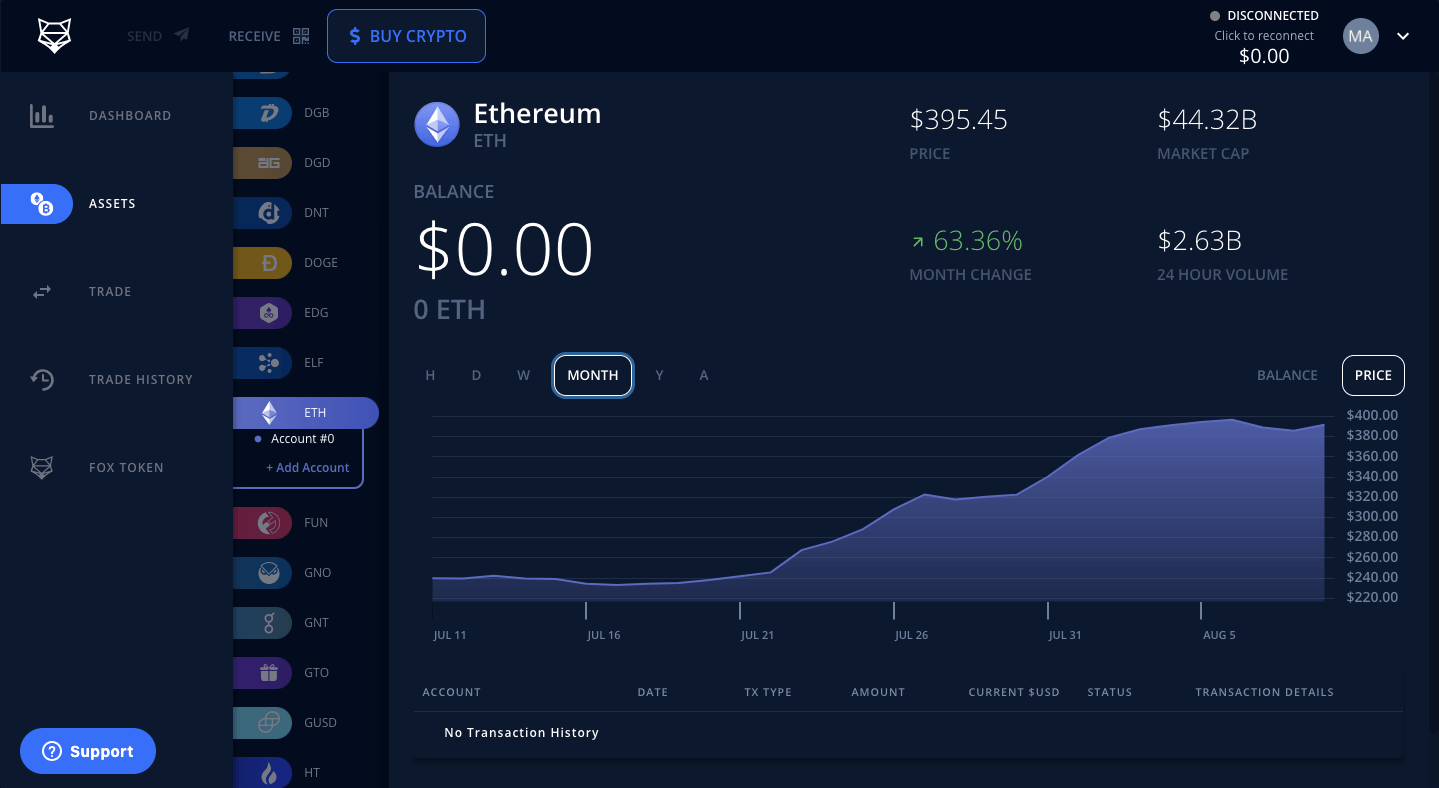
The most important security fact about ShapeShift is structural: it is a non-custodial exchange. Because ShapeShift never holds pooled user funds, there is no custodial balance for an exchange-style breach to drain. That removes custodial risk, not every risk: a compromised ShapeShift interface could still prompt you to sign a malicious approval or transaction, and you can lose funds through your own wallet or a bug in a routing protocol or smart contract you transact with. ShapeShift has built a collection of articles on best-security practices for Crypto users. Because it is non-custodial, ShapeShift works by connecting an existing Web3 wallet, such as MetaMask, rather than creating an account balance you top up.
ShapeShift fees
In the counterparty era, ShapeShift's cost was the exchange rate plus a markup, around 0.5% on top of a mid-market rate it refreshed every few seconds, and it often quoted rates near the "Google rate" for large-caps like $BTC , $ETH , and $LTC .
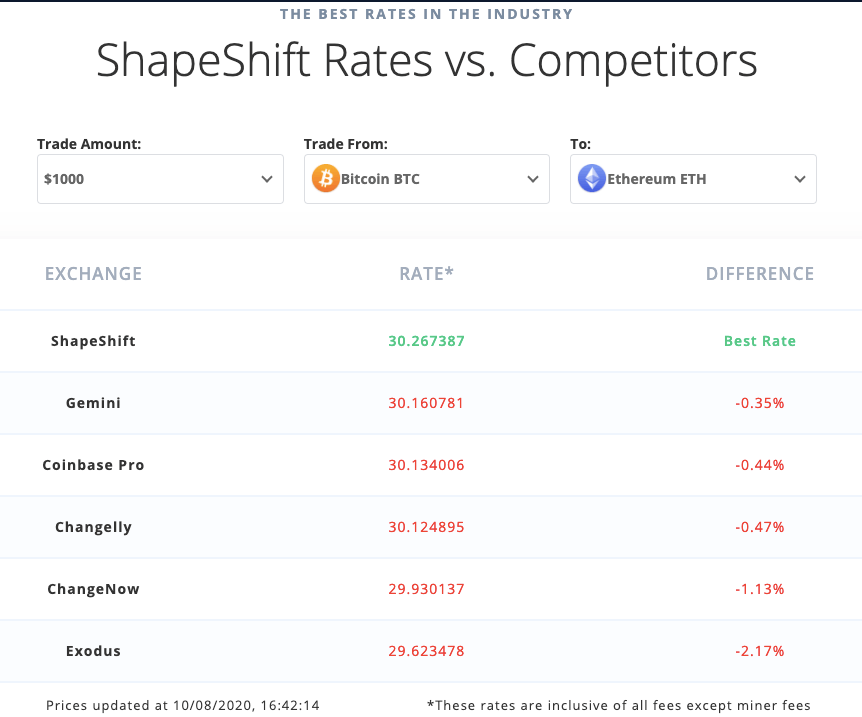
Since the move to a non-custodial aggregator, that model no longer applies. You now pay the underlying DEX and network fees on the route ShapeShift finds for a swap, plus any aggregator fee, rather than a fixed company markup. Whether that is the best available price depends on on-chain liquidity for the pair at the moment you trade, and ShapeShift appeals to people who would rather hold their own keys than leave funds on an exchange.
The original review made much of "free trading" tied to holding $FOX , where verifying an account earned tokens that zeroed out ShapeShift's markup. That program belonged to the company era and did not survive the move to a DAO; $FOX is now a governance token rather than a trading-fee rebate.
Liquidity Trading pairs
ShapeShift enjoys a considerable amount of web traffic volume, it is one of the most visited Crypto websites receiving hundreds of thousands of visitors a month. The way ShapeShift works today is fundamentally different from the model this review originally described. Until January 2021, ShapeShift was the counterparty to every trade: you traded with ShapeShift, which added its own markup on top of aggregated liquidity. That counterparty model ended as the company wound down its corporate structure ( SEC). The DAO's platform is now a non-custodial aggregator: it routes each swap to on-chain liquidity from DEXs such as Uniswap across the chains it supports, and you settle from your own wallet. ShapeShift is no longer the counterparty, it is the interface.
Because it aggregates on-chain DEX liquidity rather than maintaining a hand-picked listing, ShapeShift supports several thousand tokens across the chains it covers, and the exact count shifts as chains and routes are added.
ShapeShift now supports fiat on-ramps. Debit cards are supported in 20+ countries while other payment methods are available in 160+ countries. Your payment method will depend on where you live. For me, the routed provider was Banxa, which quoted a 2% card fee at the time; on-ramp providers and their fees vary by country and change over time. The following tokens support fiat on-ramping: $BTC , $ETH , $LTC , $XRP , $USDT , $BNB , and $LINK .
ShapeShift for Pro and Business Users
In the counterparty era, ShapeShift offered an account-based API with an OAuth flow, letting third-party apps request access to a user's ShapeShift account and execute trades through it. That model belonged to the custodial-account days. The DAO platform today exposes a developer API built around wallet-signed swaps rather than hosted accounts.
FOX token
$FOX tokens were announced in late 2019. $FOX tokens are ERC-20 tokens running on the Ethereum network, so they require an ERC-20-compatible wallet.
In the company era, $FOX functioned as a loyalty token that unlocked "free trading" once an account was verified. That is not what it is anymore.
When ShapeShift dissolved its corporate structure in 2021, $FOX became the governance token of the ShapeShift DAO: holders vote on the protocol's direction, treasury, and integrations rather than earning fee rebates. It is now openly traded rather than handed out at sign-up.
KYC/AML
"restaurants don't KYC" — Erik Voorhees
ShapeShift fought a long, public battle against mandatory KYC/AML on the platform. Voorhees argued at length that requiring a crypto-to-crypto exchange to identity-check its users made no more sense than requiring it of a restaurant, quipping that "restaurants don't KYC."
The battle was lost first and won later. In 2018, for its legal survival, the company introduced KYC, and by its own accounts more than 95% of users left. That near-death experience drove the reinvention. Rather than keep operating as a regulated company, ShapeShift dissolved its corporate structure in July 2021, open-sourced the platform, and handed control to the FOX-governed DAO, which removed the KYC requirement entirely. The platform a reader signs into today is the KYC-free, self-custody interface Voorhees had argued for all along, reached by a route almost no one would have chosen on purpose.
The corporate past was formally closed out in March 2024, when ShapeShift settled with the SEC over its earlier operation as an unregistered securities dealer, paying a penalty without admitting or denying the findings. That settlement was with the former corporate entity; the DAO that runs the platform now is a different structure.
In Summary
ShapeShift is one of the few crypto companies that solved its regulatory problem by ceasing to be a company. What began as a Swiss exchange with a counterparty model and a founder who refused to KYC ended as a KYC-free, self-custody, DAO-governed interface, with its SEC matter over the former securities-dealer operation settled. For a founder, the useful lesson is less about ShapeShift's product than about its escape route: when a business model and a regulatory regime are fundamentally incompatible, the resolution can be structural rather than cosmetic.
That structure is not right for everyone. ShapeShift is a non-custodial aggregator for people who want to hold their own keys, not a full-service exchange, and its support and roadmap run through community governance rather than a company. What it has is a track record of holding to "your keys, your crypto" even when doing so cost it most of its users.
Read Next

straight to your inbox