Understanding Maker: a beginner’s guide and review
The protocol behind DAI, the first major decentralized stablecoin on Ethereum, and its 2024 rebirth as Sky with USDS and SKYIf you've held DAI or built on MakerDAO and wondered what the 2024 Sky rebrand means for MKR, DAI, and the protocol's original design, this guide has the answer. You'll learn how Vaults and stability fees kept DAI pegged to the dollar, why MKR served as the system's governance token and backstop, and how the migration to SKY and USDS changed each of those pieces.
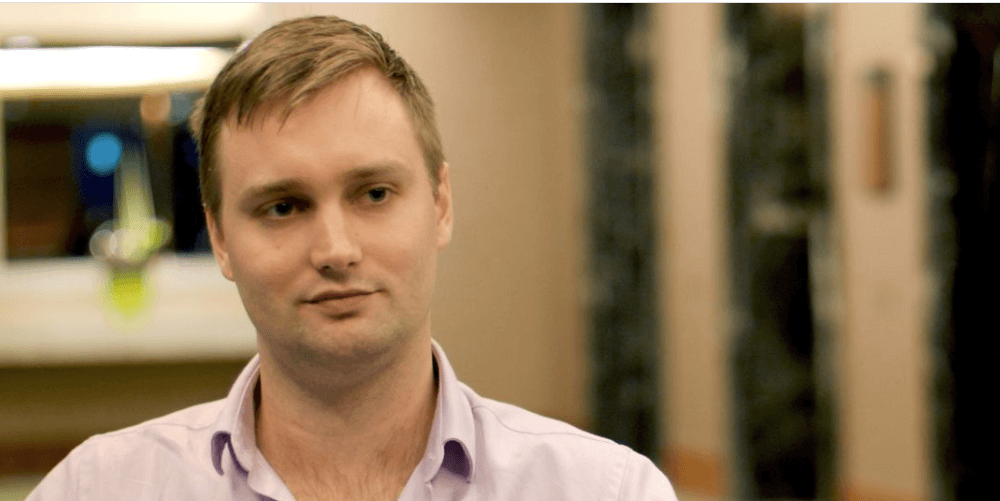
TL;DR: You can get a summary of this article in its last sectionNikolai Mushegian, MakerDAO co-founder and $DAI architect, died in San Juan, Puerto Rico on October 28, 2022, at the age of 29.
MakerDAO (often just Maker) is the credit protocol that minted the $DAI stablecoin, one of the first fully decentralized dollar-pegged assets and the first to scale on Ethereum, backed only by other crypto assets. $DAI and $MKR , the protocol’s governance token, are at the basis of so many DeFi applications that it is well worth understanding their functioning and significance. In August 2024 the protocol rebranded to Sky: $MKR became $SKY , and $DAI gained a successor called $USDS . Everything in this guide still applies; the names changed, not the ideas.
In this article, we will be taking an introductory look at Maker in order to better understand it. In this analysis of Maker, 6 different sections will be covered, as follows:
- legitimacy
- purpose
- tokenomics
- ecosystem
- the Sky era
- summary.
Legitimacy
Maker was founded in 2015 by Rune Christensen, a Danish technology entrepreneur, as an open-source project to create a permissionless credit system that would mint a USD-pegged stablecoin. This system would operate on the Ethereum blockchain and the stablecoins minted by the protocol would be backed by the collateral deposited in the protocol’s smart contracts.
Starting in 2017, the Maker team published the original
MakerDAO Whitepaper detailing the
$DAI stablecoin system and released the first iteration of it.
From that moment, the Maker Foundation, set up in Santa Cruz, California,
started raising capital from VCs by selling $MKR .
A first-round led by Andreessen Horowitz (a16z) and joined by Polychain,
Fenbushi, and others raised $12M in late 2017.
This was followed by $15M in late 2018 by a16z in solo.
Meanwhile, $MKR was sold directly to the public in the now-defunct mkr.market.
In late 2019, a $27.5M sale of $MKR was made to Paradigm.
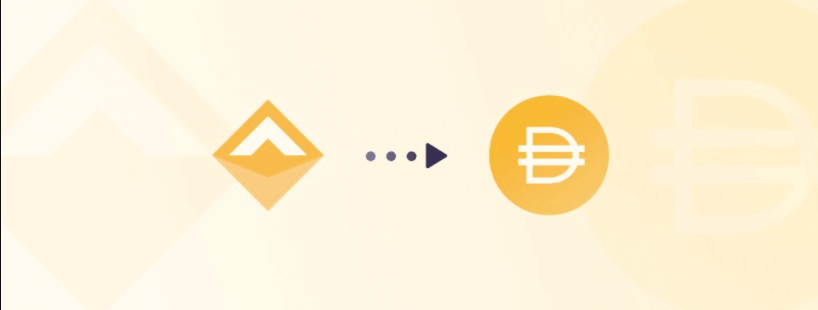
In late 2019, the second version of DAI, called multi-collateral DAI was released as detailed in the Maker Protocol Whitepaper. The new protocol and revamped stablecoin encouraged migration of the original single-collateral DAI backers from the now-old system, renamed the original $DAI into SAI as it will be phased out periodically, and gave control over to “Maker governance”. In early 2020, the Maker team decided to move the intellectual property of both Maker and $DAI into a newly-established Dai Foundation, in Denmark. The Maker Foundation and Dai Foundation exist independently of each other and have different responsibilities. The Maker Foundation expects it will be disbanded once the MakerDAO or decentralized autonomous organization can control the protocol completely.
Purpose Functionality
The purpose of Maker is to ensure a stable, transparent, and efficient mechanism to back a stablecoin and maintain a soft peg to the U.S. dollar in a decentralized and unbiased manner.
Before Maker, decentralized finance (DeFi) could not have come into existence as cryptocurrencies like $BTC and $ETH . Because of their volatility, these assets were seen as speculative instruments in and of themselves, which is why most Crypto-users trade their dollars for bitcoin. When considering the birth of lending protocols, yield balancers, and cross-chain interoperability, they only became economically viable once a single on-chain point-of-reference — a unit of account — was possible. Since a unit of account, the U.S. dollar, already exists in the world of centralized finance, the issue was how to bring it on-chain in a trustless manner.
The Maker team’s solution was to back the stablecoin, first with $ETH , and then with multiple collaterals. When collateral is deposited in the Maker smart contracts, it is locked by collateralized debt position (CDPs) — now called Vaults — and $DAI is issued in return based on their USD value, which in turn is obtained off-chain by trusted oracles that send the data on-chain. In essence, the $DAI is a loan against the crypto holdings of an individual.
Tokenomics
Anyone can interact with the protocol and receive $DAI by depositing one of the accepted assets into a Vault. The $DAI debt incurs continuously accruing interest, called a stability fee, which accrues in $DAI and is settled when the debt is repaid. (Only the original single-collateral Sai system required fees to be paid in $MKR .) The repaid $DAI is burnt, and surplus fees were periodically auctioned to buy and burn $MKR , removing it from circulation. For $MKR holders this represented an appreciation opportunity. The system constantly checks the value of the assets in the Vault against the borrowed $DAI . If the assets fall in value under the liquidation ratio, a pre-specified level of collateralization, then the Vault becomes subject to liquidation. A class of users called Keepers trigger the liquidation which sends the collateral to an open-market auction and applies a liquidation penalty on top of the outstanding $DAI .
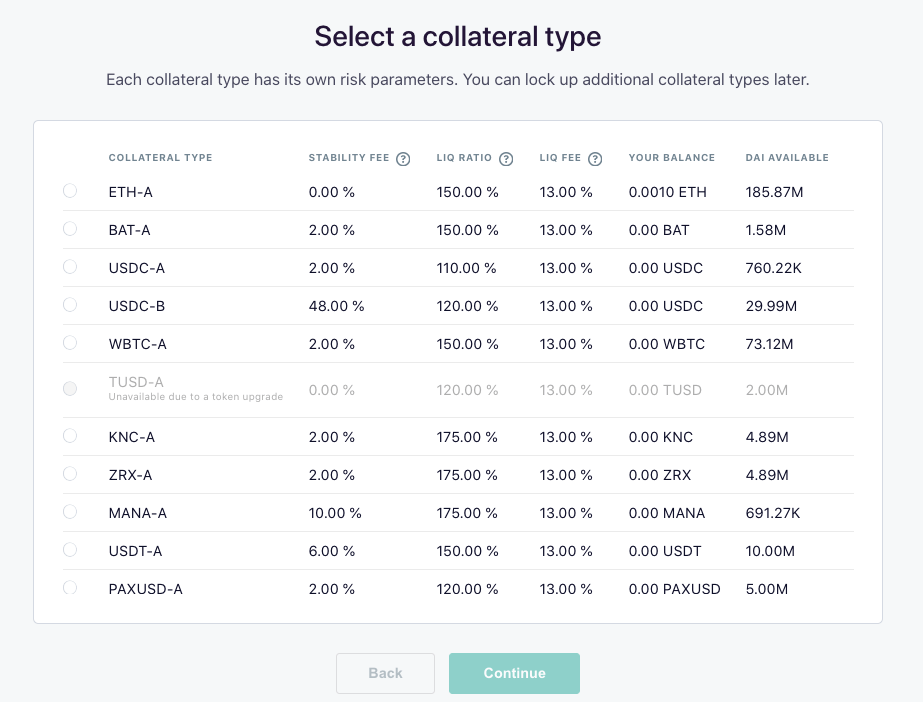
Stability fees, liquidation ratios, and liquidation penalties vary by Vault.
For example, in 2020, $DAI could be borrowed against $ETH at a minimum 150%
collateralization and a 0% stability fee, which meant that for each
$150 worth of collateral one could borrow up to 100 $DAI and didn’t have to pay
any fees unless the value of the ether fell below the 150% liquidation ratio, in
which case a 13% liquidation penalty was applied (100 DAI * 1.13 = 113 DAI)
and the collateral was auctioned off to cover the 113 $DAI , with the rest
returned to the depositor.
$MKR also acted as backup collateral in case the price of assets in Vaults dropped too quickly. $MKR could be minted and sold to make up for the lack of collateral. This would dilute the $MKR holders, and it was meant to encourage good governance for them to avoid this failsafe situation. (This backstop role carries over to $SKY today.)
A group of trusted individuals in MakerDAO also held the settlement keys to the protocol, which could activate an emergency shutdown that eventually leads to the collateral being released to $DAI holders. This could be done by a community vote as well and was meant to protect the protocol from being wiped out by attacks on its components.
$MKR and $DAI were both traded in secondary markets for years, though major exchanges delisted $MKR around September 2025 as holders migrated to $SKY .
Both $MKR and $DAI are ERC-20 tokens, so they can be stored in any ERC-20 wallet, and the same holds for their successors.
Another interesting option with Maker was the DAI savings rate (DSR). It served as a mechanism to influence the demand for $DAI . For the user, it meant the option of a “savings account” in $DAI directly in the protocol, with the interest coming from stability fees. The DSR was variable, determined by Maker governance. To earn the DSR, the $DAI had to be locked with Maker’s DSR contract. Under Sky, this mechanism lives on as the Sky Savings Rate, earned by holding sUSDS.
Ecosystem
Maker was conceived with a healthy and thriving ecosystem in mind. Its governance model, based around the MakerDAO or decentralized autonomous organization is revolutionary in its execution.
Developer Grants Program
Maker supported the Oasis app, since renamed Summer.fi, which provided a single interface to open Vaults and deposit $DAI in the DSR for savings. There was also a limited volume of trading, on the pair $wETH/$DAI .
A program to aid developers in building to increase the adoption of $DAI , open new markets, or provide novel uses for the stablecoin ran for years, with a round reopening on October 1, 2020. Grants between 5–50k $DAI could be allocated after an application with a 1-2 page clear explanation of the project and a budget. Maker followed up closely with their grantees during the development process and when co-promoting the project.
Roadmap
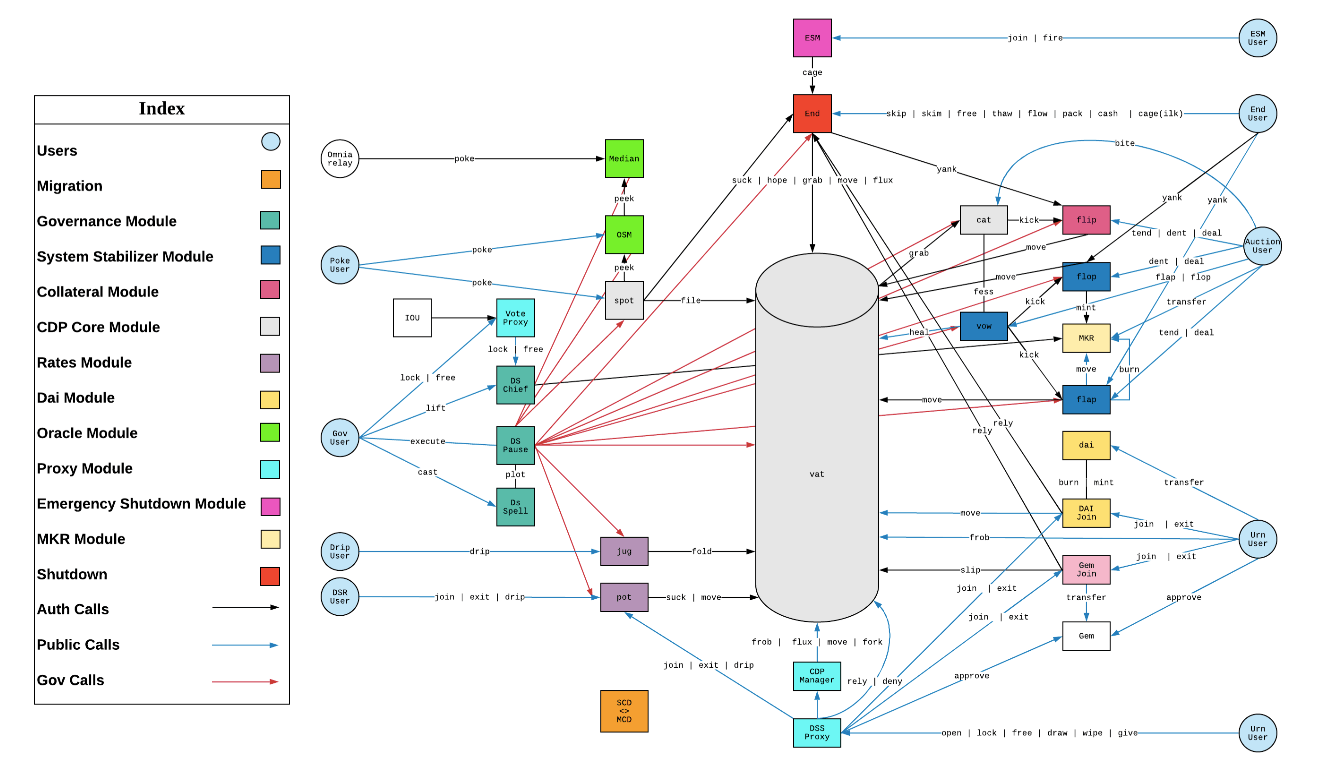
The Maker docs are an extremely detailed resource to understand the workings of the Maker protocol. They explain the architecture of the protocol and the functionality of each module, as well as how to migrate from SAI. The dynamics of auctions as well as the different user roles in the Maker protocol are also delved into. There’s a deep dive into the tooling needed to interact with and build on top of the Maker protocol (e.g. dai.js and pymaker), as well as annotations to the smart contracts, security notes, and a changelog.
For the visually inclined, there is a slide deck on the Maker protocol. For those wanting to learn, there are a number of tutorials and integration guides. The level of detail is a testament to their commitment in building a developer-first service.
Partnerships & Governance
Given that Maker is a community-governed protocol through MakerDAO, fostering a community and getting it to participate in governance as well as other roles is of paramount importance. To that end, a Maker community portal as rich as that for developers has been set up containing user guides and FAQs in several languages. You can volunteer to help Maker by providing community translations or organizing Meetups and hackathons. Microgrants are available to help out.
For $MKR holders, there was also a thorough guide on Governance in the portal; governance now happens under the Sky banner.
Though not partners in the strictest sense, a win-win network effect has been established with the other top DeFi projects by total value locked (TVL). This is the consequence of what is often called composability, or the “money legos” properties of interoperable decentralized applications on the same network (Ethereum). The best optimization strategies for a yield farmer 👨🏻🌾 will involve the use of operations across Aave, Compound, Curve, and Yearn, most of whom will use Maker as an onboarding platform to $DAI at some point.
The Sky era
On August 27, 2024, MakerDAO rebranded to Sky, the culmination of Rune Christensen’s multi-year “Endgame” plan. $MKR became $SKY at a rate of 1 $MKR to 24,000 $SKY , and $DAI holders were offered an optional 1:1 upgrade to $USDS , a new stablecoin with the same dollar peg. The DSR was superseded by the Sky Savings Rate, earned by holding sUSDS.
The migration was gradual at first, but by September 2025 major exchanges had delisted $MKR and converted user balances to $SKY . $DAI still circulates, but Sky treats $USDS as the flagship, and by 2026 it had grown into one of the largest stablecoins by supply. Practically, if you understood Vaults, stability fees, and the governance backstop described above, you already understand Sky: same machine, new nameplate.
In Summary
Maker was a reverberating accomplishment in the DeFi road to mass adoption. $DAI reigned for years as the king of decentralized stablecoins and became an essential component of the DeFi infrastructure. Its ideas now live on at a larger scale: the protocol is Sky, $MKR is $SKY , and $DAI ’s successor $USDS ranks among the biggest stablecoins in the market.
Read Next

straight to your inbox