What is DeFi?
Beginners guide to DeFi meaning, history, DeFi blockchains and apps. CeFi vs DeFi. The future of DeFi.If you've heard DeFi pitched as the future of finance and struggled to explain what actually sits under the label, this primer has the answer. You'll learn how overcollateralized lending, AMM exchanges, and asset management protocols stack into one composable system, how DeFi differs from CeFi and hybrid CeDeFi platforms, and why Ethereum still leads a multichain DeFi landscape it no longer monopolizes.
TL;DR: DeFi is the Future. For a summary, check the last section of this article.
There are many questions surrounding DeFi, a phenomenon in the making since 2017. For newcomers, DeFi offers an exciting way to understand the impact of cryptocurrencies – the pioneering implementation of Blockchain technology, now over a decade old. For avid Crypto enthusiasts, DeFi is the new frontier, a new paradigm to make money with Crypto. As common sense dictates, it is important to understand something before plunging in and dedicating time and resources. The truth is, DeFi is very new and evolving so fast, that we all need a refresher. So, what is DeFi? And, How does DeFi work? More importantly, why is DeFi important?
DeFi is short for decentralized finance, an interconnected set of decentralized applications that recreate the financial system (with its credit, derivatives, and equities markets) on the Blockchain, imbuing this new financial system with the ethos of Crypto – its open, trustless, and permissionless nature.
There is a lot of context packed into this definition. We will answer key questions as we break down the following layers and tackle them one by one:
- DeFi Blockchain
- DeFi Ethereum
- DeFi CeFi
- DeFi dApps
- Summary: DeFi is the Future.
DeFi Blockchain
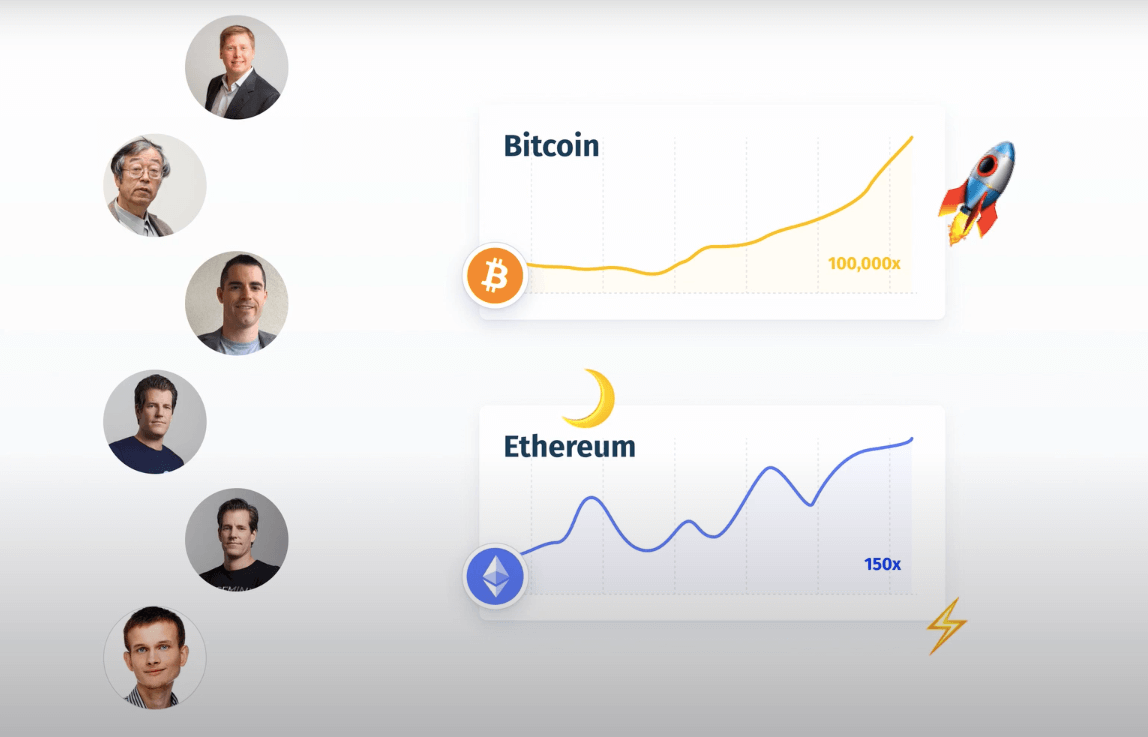
Blockchain is a topic that’s become more significant than Crypto. Although there is a whole enterprise Blockchain solutions sector, using hybrid and private Blockchain networks for various use cases and industries, including banking and financial services, when we talk about DeFi we will talk about public Blockchain networks. These include Bitcoin, Ethereum, Cosmos, Polkadot, and Cardano, among others. So, are all of these chains “DeFi”? If not, which Crypto are DeFi? Whether a particular project is part of DeFi or not has to do with its application. Many of these public networks are working to build versions of open finance, peer-to-peer (P2P) finance, and lending, swapping and stablecoin protocols. Some protocols are at the development stage with no public releases, some are at the experimental stage with few users, and others have acquired product-market fit and have thousands of users daily.
So, who invented DeFi? Well, DeFi has been a concept that’s been touted in Crypto since the very beginning, as a theoretical outcome for a programmable money of the future. The first DeFi applications scaled on Ethereum, and in the early days the term 'DeFi' was so closely associated with the Ethereum network that other blockchain ecosystems tried coining their own terms, such as TronFi for TRON and Tezfin for Tezos (neither label caught on). Ethereum led DeFi's first era and still leads today, but no longer exclusively: Solana, BNB Chain, and Base have grown into major DeFi ecosystems in their own right.
DeFi Ethereum
Ethereum remains the deepest DeFi ecosystem, holding about 53% of all DeFi value locked as of mid-2026 according to DefiLlama, so it is still the natural place to start if you want to participate in DeFi, perhaps make some money.
How to earn with DeFi? Three ways to earn in DeFi (earn yield) are depositing cryptoassets in a lending protocol like Compound or Aave, adding liquidity to a swap market in Uniswap or Balancer, and farming yield in a liquidity mining program like those run by the Synthetix derivatives market. You may also participate in the minting and stabilization of DeFi stablecoins like $DAI on Maker (rebranded to Sky in 2024). In fact, Ethereum’s choice of stablecoins ($USDT , $USDC , $DAI ) and interoperable assets from other chains like wrapped-Bitcoin ($wBTC by BitGo) is second to none. Not every wrapped asset survived, though: Ren's $renBTC and $renZEC wound down when Ren shut down after its backer Alameda collapsed with FTX in 2022, and StakeHound's staked tokens died with the project.
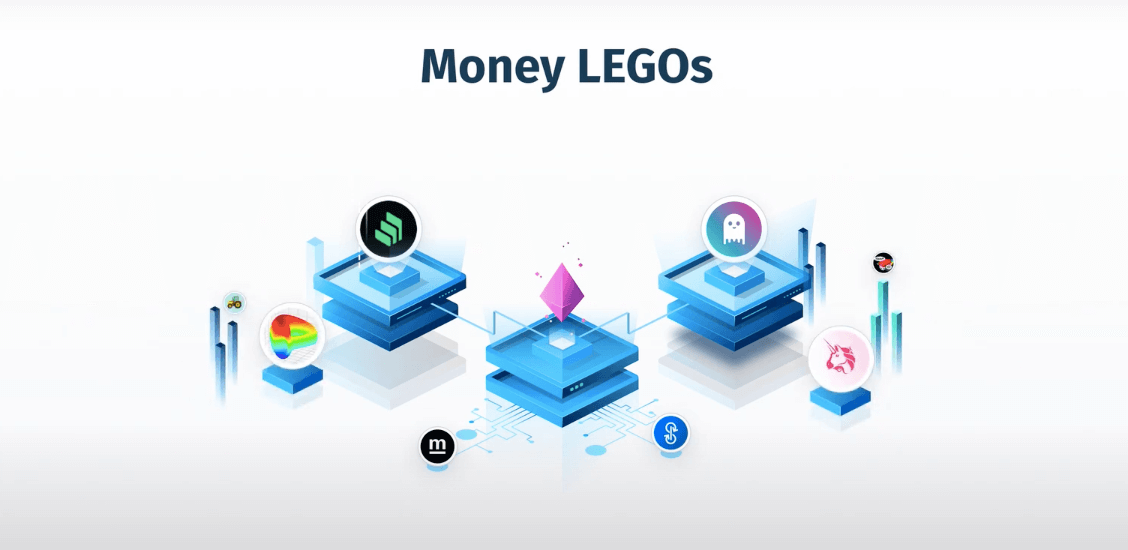
The main reason for Ethereum’s DeFi success is the fact that Ethereum is the first network where smart contracts or programs running on the Blockchain were supported at scale. Solidity, the development language of Ethereum’s smart contracts, and the Ethereum virtual machine (EVM) are familiar to a large number of Blockchain developers, who form a tight-knit community. These network effects are compounded by DeFi composability, the interconnected and inter-functional nature of the DeFi ecosystem itself. This also explains why other chain ecosystems looking to bootstrap DeFi development on their networks are building Ethereum bridges or EVM-compatibility into their network architecture.
Then, are all of the DeFi users in Ethereum? Not anymore. When DeFi first scaled in 2020, it happened almost exclusively on Ethereum: research by ConsenSys at the time counted about 300k unique active addresses that had participated in DeFi, some 15–20% of active Ethereum users by most estimates, with activity driven by “super-users” with 100+ transactions in DeFi protocols. Today the user base is far larger and spread across chains, with Solana, BNB Chain, and Base each hosting sizable DeFi communities of their own ( DefiLlama tracks the breakdown by chain).
DeFi CeFi
DeFi in some ways represents an evolution to traditional finance, or what is known in Crypto as centralized finance (CeFi). CeFi includes not only traditional banks for borrowing and lending, fund managers for chasing returns, and brokers to trade anything from stocks to commodities; but also centralized Cryptocurrency exchanges who are currently the main gateway or on-ramp for users to Crypto. The idea is that DeFi can be a better CeFi: with more censorship-resistance, with fewer barriers-to-entry, and with better-functioning markets.
CeFi argues that DeFi is too new and chaotic and users need guidance and guarantees. Some platforms like Binance famously play both sides and the middle – a hybrid they call CeDeFi. As the largest exchange in Crypto, Binance has benefited from every pump-and-dump imaginable, and naturally, they want people to “buy DeFi” through Binance. The billion-dollar question is: Can you buy DeFi? Surely, you can buy a governance token, and many do. But this is not the point of DeFi. Since DeFi is in its early-stage, many new protocols hungry for liquidity are offering a better deal: Yield Farming. Yield Farming allows users to participate in a liquidity mining program, and put their capital to work in a protocol in exchange for rewards in the form of governance tokens.

Of course, Binance wouldn’t be left behind and it also offers “yield farming” through its Launchpool division. Users can stake Binance ecosystem tokens like $BNB and get new governance tokens, usually from clones of Ethereum dApps but running on the EVM-compatible BNB Chain (launched as Binance Smart Chain and renamed in 2022). So, essentially, that’s CeDeFi – a “walled garden” like the app stores of yore.
No doubt, confused users will stay in CeFi and CeDeFi, and great UX and safer protocols and ecosystems should be one of the main drivers of increased usage in Crypto going forward. Yet, DeFi has a superb advantage over CeDeFi – fair launches. As DeFi has somewhat matured, many farmers have become choosy about where to park their liquidity. When a distribution of governance tokens isn’t fair – when there are pre-mines, VC money (or Binance money/favors), or tokensales as part of the distribution – wise or “chad” farmers take a hard pass on that project/protocol. Conversely, fair launches have become some of the most significant events for DeFi farmers. DeFi isn’t about backroom deals, it’s about community-oriented protocols!
DeFi dApps
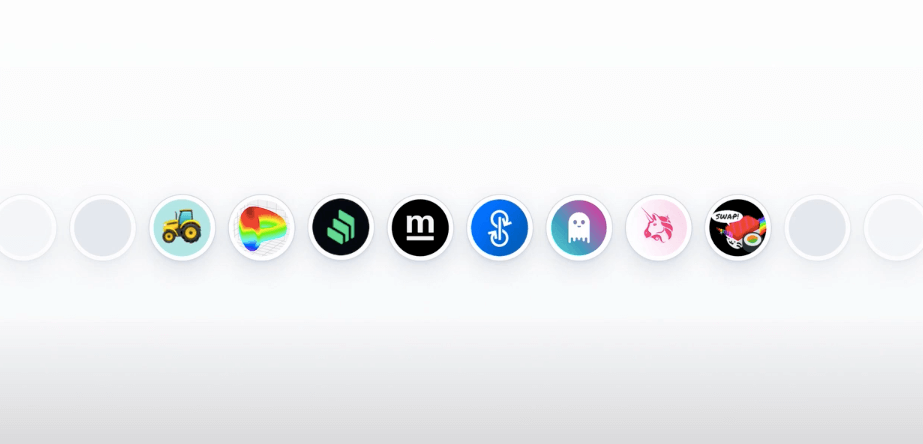
There is a lot of confusion about this. As mentioned in our definition of DeFi, DeFi is an interconnected set of decentralized applications (dApps). Basically, DeFi is a stack of financial dApps. These include:
- decentralized lending protocols: Compound and Aave, to name a few (early entrant Cream never recovered from repeated hacks in 2021).
- decentralized exchanges (DEXs): Uniswap, Balancer, and Curve are different DEXs with an automated market maker (AMM) model, Uniswap has great volume, Balancer adds programmability to liquidity itself with flexible multi-asset and weight-indexed pools, and Curve uses a modified bonding curve for ultra-low-slippage stable-asset trading (stablecoins different versions of wrapped assets). Other DEXs in DeFi’s new wave include community-owned SushiSwap and neo-orderbook Loopring, which used zkRollups and off-chain relayers to keep transaction costs down ( Loopring wound down its DEX in June 2026 after adoption collapsed).
- decentralized asset management protocols: Yearn Finance pioneered this segment by engineering the yVault, a smart contract running an investment strategy that can be updated by governance. Other protocols followed, like Pickle Finance with elastic stablecoin farming and Harvest Finance with auto-compounding (Pickle wound down in 2025 after the yield-aggregator niche thinned out). The main advantages of these protocols are saving on gas costs and 24/7 activity, but most also productize the deep research and yield-maximization strategies used by advanced investors.
There is a lot to cover, but understanding how DeFi loans work is important since a lot of yield throughout DeFi originates from the credit markets. Remember the old story of the bank taking your money from deposits and lends it out and that’s how they can pay you interest? Well, it’s not really true anymore – our fiat monetary system is based on fractional reserve banking and traditional banks print money from thin air every time they approve a loan.
DeFi loans work almost like in grandma’s story. Some users deposit money for yield. Other users want to borrow and pay back interest to do so but have to deposit collateral to get a loan. Loans get liquidated if their collateral falls below a certain threshold. All deposits and loans happen through smart contracts, which determine the yield and interest rates continuously and programmatically. This is how the largest lending protocols, such as Aave and Compound, work: the system stays solvent because it is overcollateralized, with no intermediaries, loan applications, or credit checks. Not all of DeFi follows this model, though; protocols such as Clearpool offer unsecured lending to vetted institutional borrowers, managing risk through permissioning rather than collateral. Pooled lending like this prints nothing; it just routes existing deposits. Collateral-backed stablecoins are the exception: Maker mints new DAI when a user borrows against locked collateral ( Maker docs), so the "no money printer in DeFi" line holds only for the pooled-lending model.

DEXs are also an important piece of the DeFi puzzle – often called “money LEGOs”. The AMM model has allowed for users without deep pockets to aggregate their holdings and create a market for any token in Ethereum in a permissionless and trustless manner. Users share in the trading fees, which is another way to put assets to work using DeFi.
Yield Farming is built on top of these basic blocks of financial dApps. Other non-DeFi dApps on Ethereum may find that DeFi at scale makes it simpler for them to swap their tokens (or help their users swap into their tokens), create liquidity for their cryptoasset(s), and provide a way to earn revenue on their treasury holdings or manage their treasury risks. The DeFi wave has revitalized gaming dApps, lottery dApps, and insurance dApps – it has even brought interest in non-fungible tokens (NFTs) like Crypto art, collectibles, and digital real estate to all-time highs.
Summary: DeFi is the Future
DeFi is going to change the world forever. Bringing productive assets into the Blockchain is a significant upgrade on the road to the Internet of Value. You may be wanting to learn more about DeFi to find if any DeFi tokens are worth buying. Remember, you do not need to buy anything this time – these are not the ICO times. Some people try their hand at farming, or move part of their cash into stablecoins to earn yields that can beat a bank account. Treat that as education, not advice: those returns carry real risks a savings account does not, including stablecoin depeg, smart-contract bugs, thin liquidity, custodial failure, and rates that can drop as fast as they rose. EU financial regulators warn consumers that crypto-assets can lose all their value. Never commit money you cannot afford to lose.
There are many ways to earn with DeFi: lending, providing liquidity, auto-investing to name a few – there are even derivatives, insurance risk pools, and collateral for payment networks in DeFi.
Finally, remember DeFi is just getting started. How many are using DeFi is not yet as important as who is using DeFi, and those are the pioneers that can see an exceptional upside to joining this movement early on.
Read Next


straight to your inbox